High-growth marine brands in 2026 operate with a clinical understanding of unit economics. While many mid-market boat manufacturers and marine service providers react to seasonal shifts by simply “turning up the volume” on Google Ads or Meta, elite performers treat ad spend as the last step in a rigorous optimization sequence.
As Customer Acquisition Costs (CAC) in the marine sector have risen by nearly 60% over the last decade, the margin for error has vanished. Scaling into an unoptimized funnel is no longer just inefficient,it is a fast track to eroding EBITDA.
The Pre-Scale Audit: Beyond the “More is Better” Fallacy
Before a high-performing marine brand authorizes a 20% increase in monthly ad spend, the executive team verifies five internal pillars. These pillars ensure that the increased traffic from search and social platforms actually translates into high-contract-value pipeline, rather than just vanity metrics.
1. Hardening the “Unit Economics” Foundation
Top-tier brands do not scale based on Click-Through Rate (CTR). They scale based on Contribution Margin per Lead. In the 2026 landscape, an elite marine brand knows its “True CAC” across every channel, inclusive of lead nurturing costs and the human capital required for high-touch sales.
High-performers ensure their LTV:CAC ratio (Lifetime Value to Customer Acquisition Cost) is at least 3:1 before scaling. If the ratio is lower, increasing spend only accelerates losses. They focus on “payback periods”,the time it takes for a new vessel sale or service contract to recover the initial marketing investment.
2. Validating “Digital Consensus” for AI Search
In 2026, over 37% of boat buyers and marine procurement officers begin their journey via AI tools like ChatGPT, Gemini, or Perplexity. High-performing brands understand that Generative Engine Optimization (GEO) is now as critical as traditional SEO.
Before increasing spend, these brands ensure they have “Digital Consensus.” This means their brand is cited consistently across third-party review sites, industry forums (like The Hull Truth), and news outlets. If an AI agent cannot verify your brand’s authority, your paid ads will face a “trust deficit” that no amount of creative can overcome.
The Strategic Sequence: 5 Steps to Scalable Growth
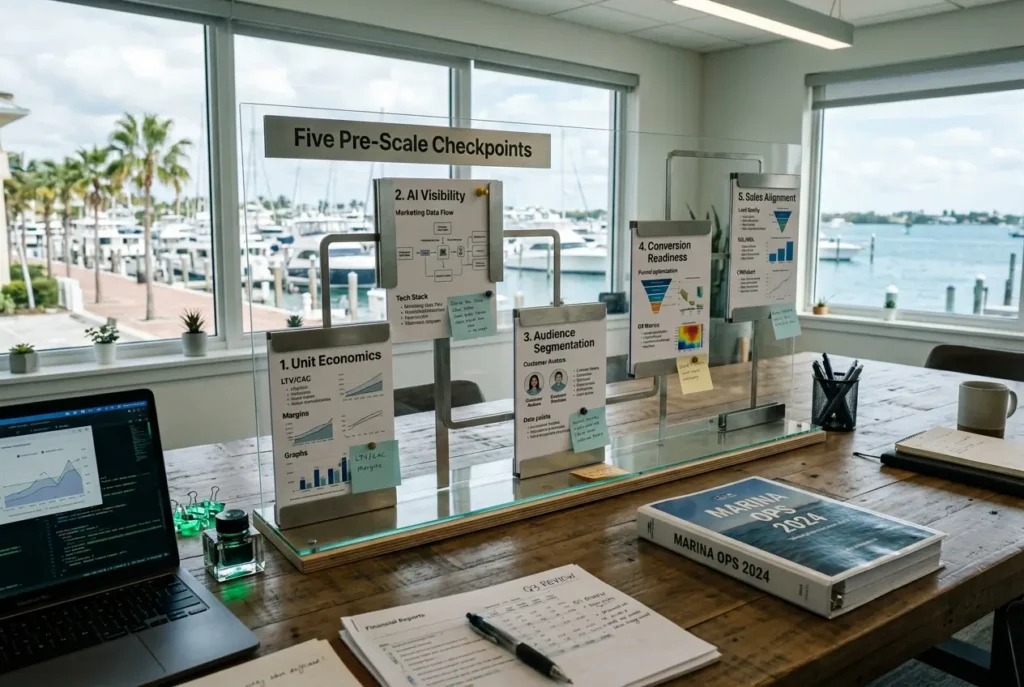
Step 1: Precision Ideal Customer Profile (ICP) Mapping
Generic “boating enthusiast” targeting is a relic of the past. High-performing brands segment their audience by Intent and Utility.
- The “Utility” Segment: Commercial operators, charter fleets, and professional anglers focused on durability and ROI.
- The “Leisure” Segment: High-net-worth individuals focused on “Return on Experience” (ROE) and status.
Each requires a distinct conversion path. Scaling spend before these paths are bifurcated leads to “diluted messaging,” where neither segment feels the brand speaks to their specific pain points.
Step 2: Conversion Rate Optimization (CRO) of the Destination
Elite brands treat their landing pages as “Sales Engineers.” Before scaling spend, they aim for a minimum visitor-to-lead conversion rate of 3–5% for high-intent queries.
They utilize Tactile Digital Experiences,interactive vessel configurators, 360-degree virtual engine room tours, and AI-powered “Cost of Ownership” calculators. If these assets aren’t converting at current traffic levels, more traffic will only lead to more “bounces.”
Step 3: Implementing “Smarketing” Alignment
Scaling spend creates a surge in leads that can overwhelm a traditional sales team. High-performers implement a Service Level Agreement (SLA) between Marketing and Sales.
- Marketing agrees to deliver “Sales Ready Leads” (SRLs) with verified intent.
- Sales agrees to a “speed-to-lead” response time of under 10 minutes for high-value inquiries.
Step 4: Full-Funnel Content Architecture
High-performing brands do not rely solely on “Bottom of Funnel” (BOFU) ads. They allocate 20–30% of their budget to “Top of Funnel” (TOFU) awareness. This creates a “demand moat.” By the time a prospect searches for a specific keyword, they have already encountered the brand’s authoritative content (whitepapers on marine lithium-ion safety, reports on carbon-neutral hull designs, etc.).
Step 5: Testing for Incrementality
Before a massive budget hike, these brands run Incrementality Tests. They shut off ads in specific geographic regions to see the impact on “organic” sales. This ensures that their ad spend is actually driving new growth, rather than just paying for clicks they would have received anyway.
Strategic Conclusion: The Discipline of Scale
The difference between a “market leader” and a “market participant” in the marine industry is the discipline to say “no” to scaling until the foundation is solid. In an era of AI-driven search and rising costs, the brands that win are those that prioritize E-E-A-T (Experience, Expertise, Authoritativeness, and Trustworthiness) over raw impression volume.
Before you increase your ad spend, audit your unit economics, verify your AI visibility, and ensure your sales team is ready for the surge. Growth is a science of precision, not a gamble of volume.
Ready to Optimize Your Marine Growth Engine?
If you are evaluating your 2026 marketing budget and need a second opinion on your funnel’s “scale-readiness,” let’s talk. Request a strategic funnel audit.
FAQ: Scaling Marine Advertising in 2026
How do I know if my marine brand is ready to increase ad spend?
A brand is ready to scale when it has a stable LTV:CAC ratio of 3:1 or higher, a landing page conversion rate exceeding 3%, and a documented sales follow-up process that handles current leads within 10 minutes. If your “back-office” operations are struggling with current lead volume, increasing ad spend will result in a “leaky bucket” where expensive leads go cold before they are contacted.
What is the most important KPI for marine industry advertising in 2026?
While CTR and CPC are important for tactical monitoring, the executive-level KPI is Pipeline Contribution. This measures the total dollar value of the sales pipeline generated by marketing activities versus the total investment. In 2026, high-performing brands also track AI Citation Share,how often their brand is recommended by LLMs compared to competitors,as this is a leading indicator of future organic and paid efficiency.
Does “Brand Awareness” spend actually drive ROI in the marine sector?
Yes, but only when measured through the lens of “Assisted Conversions” and “Brand Search Volume.” Marine purchases are high-consideration and long-cycle. TOFU (Top of Funnel) spend reduces the cost of BOFU (Bottom of Funnel) conversion by building trust early. Brands that only spend on “Buy Now” keywords often see their CAC spiral upward as they compete in a “bidding war” for the same 5% of active buyers.
How does AI search (GEO) change how I should allocate my ad budget?
GEO requires a shift toward Earned and Owned Media. You should allocate a portion of your budget to creating high-density, factual content (case studies, technical specs, expert interviews) that AI models can easily crawl and cite. If your brand is invisible in “AI Overviews,” your paid search ads will have to work twice as hard to convince a skeptical buyer who didn’t see you in the AI’s “top recommendations.”