In the U.S. marine industry, increasing ad budgets often feels like the fastest way to grow. However, scaling paid advertising before fixing structural inefficiencies almost always leads to amplified waste. The issue is rarely budget size, it is precision.
Boat repair companies, yacht detailing businesses, marine engine service providers, and dockside repair operators across South Florida, the Gulf Coast, and coastal California frequently invest in Google Ads and local paid campaigns. Yet many experience the same symptoms: high cost per lead, inconsistent booking volume, and low close rates.
Before scaling ad spend, marine companies must identify where their marketing system is leaking. Scaling campaigns without predictable performance turns marketing into operational risk.
Efficiency before scale: what actually impacts roi in marine advertising
In competitive U.S. markets, keywords such as:
- “boat repair near me”
- “emergency marine service Miami”
- “yacht detailing Fort Lauderdale”
- “marine engine repair Florida”
carry significant cost-per-click (CPC). That means even minor targeting mistakes create immediate financial waste.
The most common causes of wasted ad spend in marine digital marketing include:
- Overly broad geographic targeting that reaches outside real service areas
- Heavy reliance on informational keywords instead of transactional intent
- Lack of negative keyword filtering
- Ad copy that attracts curiosity instead of qualified prospects
- Landing pages that fail to convert traffic into booked jobs
If these issues remain unresolved, increasing budget simply accelerates inefficiency.

(Chart comparing “Ad Spend” vs. “Qualified Bookings,” showing rising investment without proportional growth in confirmed services.)
Geographic targeting: where marine companies lose money
Location is not a minor detail in marine marketing, it is the core driver of profitability. A marine repair company serving specific marinas in South Florida or the Gulf Coast should not run statewide campaigns without precise geo-targeting.
Poor geographic structure often results in:
- Clicks from outside operational routes
- Leads that are too far to service profitably
- Budget drained in areas with low vessel density
An optimized campaign structure should define:
- High-priority marinas
- Strategic ZIP codes
- Regions with higher boat ownership density
- Coastal markets with stronger average ticket value
Precision targeting improves lead quality before any budget increase.
Keywords that drive traffic, but not revenue
One of the most expensive mistakes in marine Google Ads campaigns is targeting high-volume, low-intent keywords. Terms like:
- “how to fix a boat motor”
- “boat maintenance tips”
- “best fishing boats”
attract researchers, not buyers.
Before scaling ad budgets, marine companies should prioritize:
- High-intent transactional keywords
- Localized commercial searches
- High-ticket service-specific queries
This includes targeting phrases such as:
- “emergency boat repair near me”
- “yacht repair Fort Lauderdale marina”
- “fiberglass hull repair Miami”
- “marine engine diagnostic service”
By focusing on commercial search intent, cost per qualified lead often decreases before any additional budget is required.
Landing Pages: the invisible profit leak
Many U.S. marine companies invest heavily in Google Ads while sending traffic to generic service pages. In high-CPC markets, this is a direct path to wasted ad spend.
A high-performing marine landing page should:
- Clearly state service area
- Highlight technical specialization
- Showcase real customer reviews
- Emphasize emergency response capability
- Provide one-click call functionality
If the page does not convert, the problem is not the budget, it is conversion optimization.

(Dashboard comparing “Cost Per Click,” “Cost Per Qualified Lead,” and “Cost Per Booked Job,” highlighting performance bottlenecks.)
Data before decision: the foundation of smart scaling
Marine businesses that scale successfully do not rely on vanity metrics like impressions or raw lead volume. Instead, they track performance indicators that directly impact profitability, including:
- Cost per qualified lead
- Actual close rate
- Average service ticket value
- Return on ad spend (ROAS)
- Operational capacity
Without full integration between paid campaigns, call tracking systems, and CRM data, scaling decisions are speculative. Marine marketing requires measurable predictability before expansion.
When it actually makes sense to scale
Scaling ad budgets becomes strategic, not risky, when:
- Close rates are consistent
- Cost per acquisition is stable
- The operational team can handle additional demand
- Margins support increased volume
Scaling before these conditions are met creates financial instability and operational pressure.
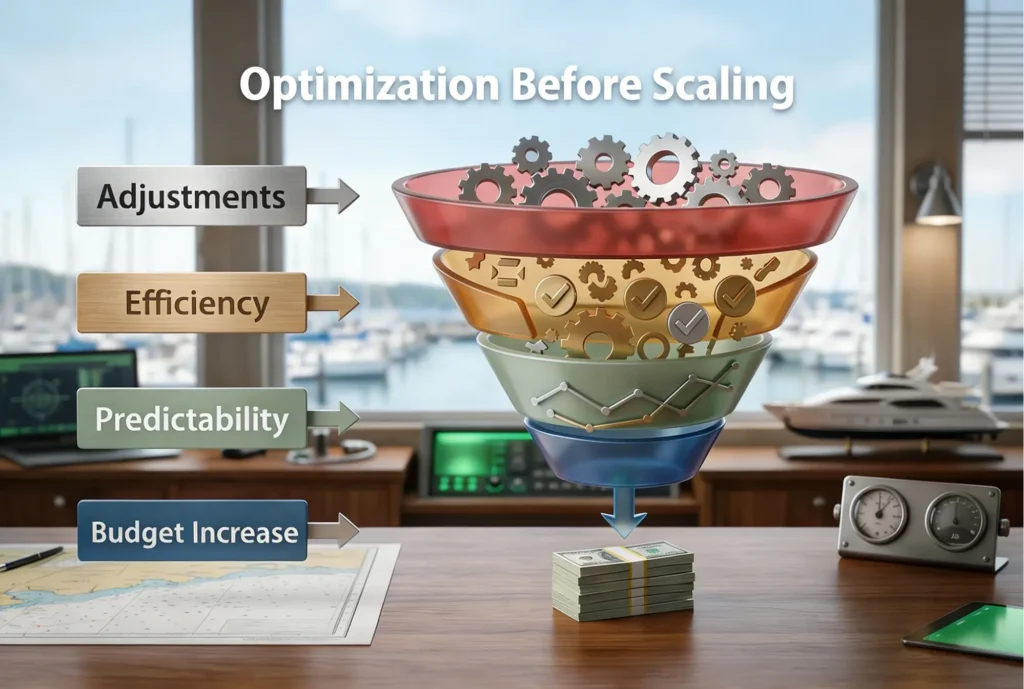
Visual funnel illustrating optimization before scale: adjustments → efficiency → predictability → increased ad budget.
Sustainable growth: the Savage Global Marketing approach
At Savage Global Marketing, scaling ad budgets is never the first step. Eliminating wasted ad spend comes first. As a performance-driven marine marketing agency, the strategy integrates:
- Precision geo-targeting in competitive U.S. coastal markets
- Intent-driven keyword strategy for marine SEO and paid search
- Conversion-optimized landing pages
- Advanced call tracking and revenue attribution
Only after predictable ROI is validated does scaling become a growth accelerator instead of a financial gamble.
Ready to scale without wasting budget? Schedule a strategy call with Savage Global Marketing and discover how to optimize your marine advertising structure before increasing your ad spend.
FAQ
1. How long should a marine company test Google Ads before increasing the budget?
Most marine companies should run optimized campaigns for at least 60 to 90 days before scaling budgets. This timeframe allows enough data to evaluate cost per qualified lead, close rates, seasonal demand patterns, and service profitability. Scaling too early often amplifies unproven assumptions rather than validated performance.
2. What metrics must be stable before scaling paid ads in the marine industry?
Before increasing ad spend, marine businesses should see consistent cost per acquisition, predictable close rates, stable cost per qualified lead, and positive return on ad spend (ROAS). Operational capacity should also be aligned to handle additional service volume without compromising quality.
3. How much should a boat repair or yacht service company invest in Google Ads per month?
Monthly ad budgets vary based on competition and location. In competitive coastal markets such as South Florida or California, marine companies often require higher budgets due to elevated CPC rates. The correct budget is not defined by industry averages, but by the cost required to generate profitable booked jobs within a specific service area.
4. Is Google Ads or Facebook Ads better for marine service companies?
Google Ads typically captures high-intent searches, especially for emergency boat repair and local marine services. Facebook and Instagram ads are more effective for brand awareness, retargeting, and showcasing yacht detailing or upgrade services. The strongest marine marketing strategies combine both channels based on intent and service type.