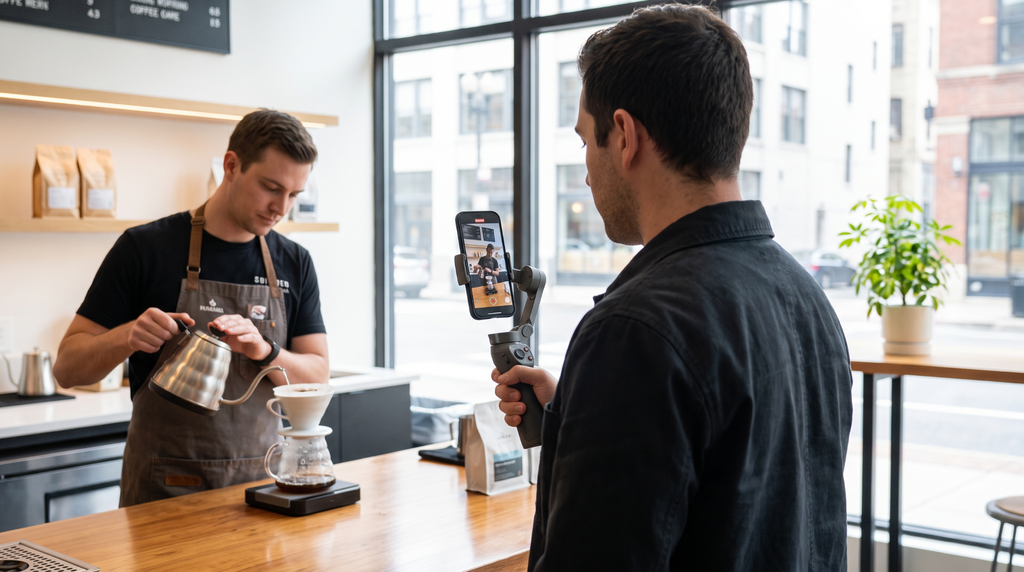
Social media content creation is the process of planning, producing, publishing, and improving content designed for platforms such as Instagram, Facebook, LinkedIn, TikTok, and YouTube. But creating content consistently is not the same as creating content that performs.
Strong social content starts with a clear audience, a specific objective, and an understanding of how people consume information on each platform. The format, message, hook, and call to action should all support what the business wants the audience to think, feel, or do next.
The objective is not simply to fill a content calendar. It is to build a system that consistently earns attention and moves the right audience closer to the brand.
What Is Social Media Content Creation?
Social media content creation includes everything required to turn a marketing idea into content that can be published and measured.
Depending on the strategy, that can involve:
- audience research;
- content planning;
- copywriting;
- graphic design;
- photography;
- video production;
- Reels and short-form video;
- carousels;
- educational posts;
- customer stories;
- thought leadership;
- editing;
- captions;
- publishing;
- performance analysis.
The process should begin before anyone opens a design tool or camera. Businesses first need to understand who the content is for and what role it should play in the customer journey.
A post designed to introduce a brand should not necessarily look or sound like content intended to convert someone who already knows the company. This is why effective content creation depends on strategy rather than production volume alone.
Start With the Audience Before Choosing the Content

A common mistake is beginning with the question: “What should we post this week?”
A stronger question is: “What does our audience need to understand, believe, or solve?”
Content becomes more relevant when it reflects the problems, questions, objections, and interests of the people the business wants to reach.
Audience research can come from:
- sales conversations;
- customer questions;
- support tickets;
- comments and direct messages;
- search data;
- reviews;
- competitor conversations;
- frequently asked questions;
- sales objections;
- social media analytics.
The objective is not to guess what might be interesting. It is to identify recurring themes that already matter to potential customers.
“The strongest content ideas usually don’t come from sitting in a room trying to be creative. They come from paying attention to what customers keep asking, what they misunderstand, and what prevents them from taking the next step.”
Mariana Silva – Social Media Specialist
This also helps brands avoid creating content entirely around themselves. Company news and promotional posts have a place, but a social feed becomes much stronger when it consistently gives the audience a reason to pay attention.
Build Content Pillars Instead of Posting Random Topics

Content pillars are recurring themes that organize what a brand talks about.
Rather than creating unrelated posts every week, businesses can define several strategic categories connected to the audience and business objectives.
For example, a service company might use:
| Content Pillar | Purpose |
| Education | Explain problems, processes, and solutions |
| Expertise | Demonstrate knowledge and point of view |
| Proof | Show results, testimonials, or examples |
| Brand | Communicate people, culture, and positioning |
| Offer | Explain services and encourage action |
A beauty brand might use completely different pillars: Education → Transformations → Product → Behind the Scenes → Customer Stories
The exact categories matter less than whether they provide enough variety while reinforcing what the company wants to be known for.
Content pillars also make planning easier. Instead of generating ideas from zero each month, the team can develop new angles within established strategic themes. That creates consistency without requiring every post to look identical.
Choose the Right Format for the Message
Not every idea should become a Reel. And not every idea should become a carousel. The best format depends on what the content needs to communicate.
Short-Form Video
Video works well when the audience benefits from seeing or hearing the subject directly.
Examples include:
- demonstrations;
- opinions;
- quick explanations;
- before-and-after content;
- behind-the-scenes moments;
- interviews;
- customer stories;
- reactions;
- process videos.
Short-form video can also help brands communicate personality and humanize expertise.
LinkedIn’s 2026 B2B marketing guidance identifies video as a foundational format for building engagement, trust, and connection rather than simply a temporary trend. LinkedIn’s research cited in that guidance found that 78% of B2B marketers were already using video, with more planning to increase their use.
Carousels
Carousels work particularly well when an idea needs structure.
They can be useful for:
- step-by-step explanations;
- checklists;
- frameworks;
- comparisons;
- mistakes;
- educational breakdowns.
The user can consume the information gradually rather than processing everything in one image.
Static Images
Static content can still be useful when the message is simple enough to communicate quickly.
Examples include:
- strong statements;
- announcements;
- testimonials;
- visual proof;
- promotional messages.
The important point is to select the format based on the idea and audience behavior, not because one format is currently popular.
“A content format should make the message easier to consume. If the idea needs demonstration, video may be stronger. If it needs structure, a carousel may work better. The strategy should choose the format, not the other way around.”
Mariana Silva – Social Media Specialist
Create Strong Hooks Without Turning Every Post Into Clickbait
Social media content competes for attention immediately. That makes the opening especially important.
In video, the hook may appear in the first sentence or visual. In a carousel, it is usually the first slide. In a text-based post, it is the opening line.
Strong hooks generally do one of several things:
- identify a specific problem;
- create curiosity;
- challenge an assumption;
- promise a useful outcome;
- introduce a surprising point of view;
- speak directly to a recognizable situation.
For example:
Weak: “Here are some tips for improving your social media.”
Stronger: “Posting every day won’t fix a social strategy that has nothing useful to say.”
Or:
Weak: “5 website tips.”
Stronger:“Your website may be getting traffic and still losing potential customers.”
The hook should create enough interest to earn attention without making a promise the content does not deliver.
For video, retention also matters after the opening. YouTube explains that its Shorts recommendation systems consider whether viewers choose to watch or ignore a Short, along with average view duration, average percentage viewed, likes, and other satisfaction signals. A strong hook gets the audience to start watching. The rest of the content has to justify staying.
Make Social Content Native to the Platform
Repurposing content is useful. Copying and pasting the exact same execution across every platform usually is not.
Each platform creates a different viewing environment. A LinkedIn user may be more receptive to professional insight, commentary, or industry experience. An Instagram user may encounter the same idea through a Reel, carousel, or visual story. YouTube Shorts places the content inside a rapid video discovery environment.
The core idea can remain consistent while the execution changes.
For example, one customer interview could become:
- a 45-second Instagram Reel;
- a longer LinkedIn video;
- three quote graphics;
- a carousel about the customer’s problem;
- a YouTube Short;
- a written LinkedIn post;
- clips for paid social.
This approach increases the value of the original production without forcing every channel to behave the same way.
Meta’s Reels guidance also emphasizes creative designed specifically for the placement, including vertical video, audio, and keeping key messaging within the appropriate safe zone.
The more naturally content fits the environment, the less it feels like something simply recycled because the calendar needed another post.
Build a Content System, Not an Endless Production Cycle
Social media becomes difficult when every post starts from zero. A stronger approach creates a repeatable production system.
A basic workflow might look like:
Research → Ideas → Content Calendar → Script/Copy → Production → Approval → Publishing → Analysis → Repurposing
Each stage should have clear responsibilities. For example:
Research
Collect customer questions, trends, sales insights, and performance data.
Planning
Turn those insights into themes and specific content ideas.
Production
Write scripts, captions, graphics, or filming plans in batches where possible.
Publishing
Adapt each piece to the platform and schedule.
Analysis
Identify what generated meaningful attention and audience response.
Repurposing
Use strong ideas again in different formats or with new angles.
Batch production can make this significantly more efficient. Instead of filming one Reel every few days, a business can plan several concepts and record multiple assets during the same production session.
The goal is not to automate creativity. It is to remove unnecessary operational friction so the team can spend more time improving the content itself.
How Often Should Businesses Post on Social Media?
There is no universal posting frequency that guarantees growth. Publishing more content can create more opportunities to reach people, but increasing volume only works when the business can maintain relevance and quality.
YouTube explicitly states that there is no minimum posting frequency required for Shorts to perform well and recommends finding a frequency that works for the audience while focusing on strong content.
The same principle is useful across platforms. A company publishing three valuable posts each week may build a stronger presence than one publishing twice a day with repetitive or generic content.
Businesses should choose a cadence they can sustain consistently without turning production into filler.
That may mean:
- several posts each week;
- frequent short-form video;
- fewer but more developed thought-leadership posts;
- a combination of formats.
The ideal frequency should come from capacity + audience behavior + performance, not from an arbitrary social media rule.
Measure Content Based on Its Purpose

A high-performing social media post is not necessarily the post with the most likes. Different content has different jobs.
For example:
| Content Goal | Useful Metrics |
| Awareness | Reach, impressions, video views |
| Attention | Watch time, retention, completion |
| Engagement | Comments, shares, saves |
| Traffic | Link clicks, website visits |
| Demand | Profile visits, branded searches, inquiries |
| Conversion | Leads, appointments, purchases |
This is why comparing every post based on one metric can be misleading. An educational carousel may generate many saves but few comments. A strong opinion may generate conversation. A testimonial may receive fewer impressions while influencing someone who is already considering the business. Social media reporting should look for patterns over time.
Questions to ask include:
- Which topics consistently earn attention?
- Which hooks improve retention?
- Which formats generate saves or shares?
- Which posts attract the right audience?
- Which content produces profile visits?
- Which content contributes to inquiries?
- Which ideas repeatedly underperform?
“A post shouldn’t be considered successful just because it got more likes. Performance depends on what that piece of content was designed to accomplish. A Reel built for discovery and a testimonial built for trust should not be evaluated the same way.”
Mariana Silva – Social Media Specialist
The objective is to use performance data to decide what to create next, not simply to report what already happened.
Should Businesses Follow Social Media Trends?
Trends can create opportunities, but they should not become the strategy. A popular audio, editing style, meme, or format can help content feel current when it makes sense for the audience and brand.
The problem occurs when companies repeatedly force themselves into trends with no connection to their positioning.
LinkedIn’s 2026 marketing guidance makes a similar argument for B2B brands: long-term performance depends more on mastering foundational marketing principles than constantly chasing novelty.
A practical filter is: Does this trend help us communicate something relevant to our audience? If yes, adapt it. If not, skip it.
Brands do not need to participate in every conversation on the internet to remain relevant.
How Can AI Support Social Media Content Creation?
AI can make content operations faster, but it should support the process rather than define the entire brand voice.
Useful applications include:
- brainstorming angles;
- organizing research;
- generating first-draft scripts;
- turning one idea into multiple formats;
- creating caption variations;
- summarizing interviews;
- analyzing recurring audience questions;
- supporting content calendars.
The risk is producing large amounts of content that sounds interchangeable with everything else online.
Original expertise, customer insight, brand perspective, real examples, employees, founders, customers, and behind-the-scenes material become increasingly valuable when generic information can be generated instantly. AI can accelerate production. It cannot replace having something meaningful to say.
When Does Professional Social Media Content Creation Make Sense?
Professional content creation becomes particularly useful when the business understands the value of social media but cannot maintain the required strategy and production internally.
Common signs include:
- inconsistent posting;
- lack of content ideas;
- poor-quality video;
- no clear content pillars;
- strong expertise that is not being communicated;
- teams that do not have time to create content;
- social accounts that feel disconnected from the brand;
- content being published without performance analysis.
Professional support can also become valuable when video production becomes a larger part of the strategy.
Planning, scripting, filming, editing, design, publishing, and analysis require different skills. As the volume and complexity increase, assigning all of those responsibilities to one internal employee can become difficult.
For businesses that need strategy and production working together, Savage can connect social media planning, design, video, publishing, and performance around a consistent brand message rather than treating every post as an isolated deliverable.
Frequently Asked Questions
What is social media content creation?
Social media content creation is the process of researching, planning, producing, publishing, and improving content for platforms such as Instagram, Facebook, LinkedIn, TikTok, and YouTube. It can include video, graphics, carousels, written posts, photography, and other formats.
What type of social media content performs best?
There is no single format that performs best for every brand. Video can be useful for demonstrations and human connection, carousels for structured education, and static content for simpler messages. The right format depends on the audience, platform, objective, and idea.
How often should a business create social media content?
Businesses should choose a frequency they can sustain without sacrificing relevance and quality. There is no universal minimum frequency. YouTube, for example, explicitly states that Shorts do not require a minimum posting cadence to improve performance.
What are social media content pillars?
Content pillars are recurring strategic themes used to organize a brand’s content. Examples may include education, expertise, customer proof, brand culture, and services. They help maintain consistency while creating enough variety for ongoing publishing.
Should every business create video content?
Not every post needs to be video, but video can be an important format when demonstrating products, explaining complex ideas, showing people behind the brand, or building trust. LinkedIn’s 2026 B2B research shows video is already widely used by B2B marketers across awareness, trust, and conversion goals.
Can the same content be used on every social platform?
The same core idea can often be repurposed, but the execution should usually be adapted. Format, length, opening, visual style, caption, and call to action may need to change depending on how users consume content on each platform.
How do you know if social media content is working?
Measure performance according to the content objective. Reach and views can indicate awareness, watch time can indicate attention, saves and shares can indicate usefulness, while website visits, inquiries, leads, and sales provide stronger signals of commercial impact.
Build Content People Have a Reason to Consume
Effective social media content creation is not about publishing as much as possible. It is about consistently creating content that is relevant to the audience, appropriate for the platform, and connected to a clear business purpose.
That requires more than design or editing. Audience insight, content pillars, strong ideas, platform-native formats, effective hooks, consistent production, and performance analysis all need to work together.
When those pieces are connected, social media becomes more than a publishing calendar. It becomes a system for building attention, trust, and demand over time.
For businesses that need a more consistent social media presence, Savage can help connect strategy, creative production, video, publishing, and ongoing content development around the goals of the brand.
Talk to the Savage team about your social media strategy, current content challenges, and the audience you want to reach. The team can help build a content creation approach designed around your brand, platforms, and broader marketing goals.