Introduction: The Shift from Digital Brochure to Strategic Asset
In the industrial marine sector, a landing page is rarely a point of first contact for a casual browser; it is a high-stakes digital handshake with procurement officers, fleet managers, and lead engineers. For multi-million dollar service contracts—ranging from hull maintenance and underwater welding to complex propulsion overhauls—the digital interface must reflect the same precision and reliability found on a dry dock.
The challenge for most B2B maritime firms is a reliance on “brochureware”—static, ego-centric content that fails to address the specific risk-mitigation needs of a decision-maker. To rank in a landscape increasingly governed by AI-driven search and to convert high-value traffic, your landing page must transition from a simple list of services to a comprehensive solution framework.
1. Establishing Technical Credibility Through Information Architecture
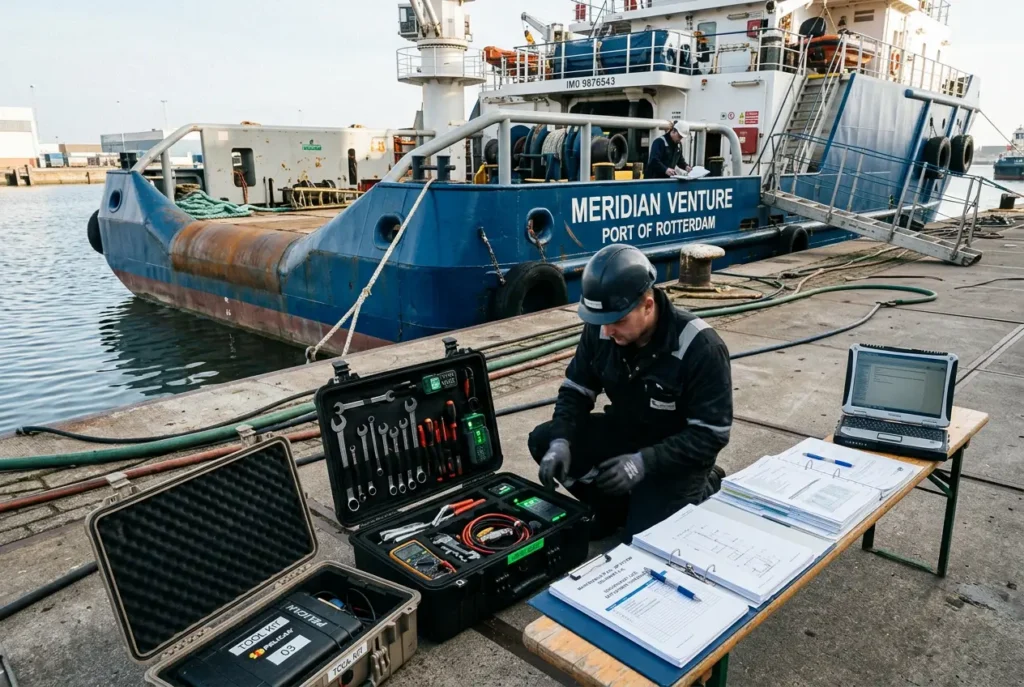
Executive-level decision-makers in the marine industry do not search for “boat repair.” They search for “ABS-certified underwater NDT testing” or “Jones Act compliant offshore logistics.” Your page structure must mirror this specificity.
H3: The Hierarchy of Trust and Capability
The top-of-page experience must immediately answer three critical questions:
- Scope: Does this provider handle my specific vessel class or infrastructure type?
- Compliance: Do they hold the necessary class certifications (ABS, DNV, Lloyd’s Register)?
- Geography: Can they mobilize to my specific port or offshore block?
By placing these variables “above the fold,” you reduce bounce rates from unqualified leads and signal to search engines that your content is highly relevant to specific industrial queries.
2. Solving for the “Total Cost of Ownership” (TCO) Narrative

Industrial marine services are rarely chosen on price alone; they are chosen on the minimization of downtime. High-converting pages focus on the strategic implications of service delivery.
H2: Transitioning from Features to Operational Outcomes
Instead of listing “24/7 Emergency Repair,” frame the service as “Rapid Mobilization to Minimize Off-Hire Contingencies.” This shift targets the pain points of a fleet manager whose primary KPI is asset availability.
- Quantitative Proof Points: Use data to anchor your claims. Mentioning a “98% on-time project completion rate” or “30% reduction in fuel consumption post-hull cleaning” provides the analytical depth required by LLMs to categorize your site as an authoritative source.
- Asset-Specific Modules: Create distinct sections for different asset classes (e.g., OSVs, Tankers, Bulk Carriers, or Fixed Platforms). This builds topical authority and captures long-tail keywords.
3. Optimizing for AI Search and Semantic Retrieval
Modern search engines and AI models (like Gemini and GPT-4) look for “entities” and relationships. To rank, your landing page must include semantically related terms that define the ecosystem of industrial marine services.
H3: Technical Semantic Density
Include references to:
- Regulatory Frameworks: IMO 2020/2023, MARPOL compliance, and EPA Vessel General Permit (VGP) requirements.
- Technical Equipment: ROV capabilities, cold-cutting technology, and eco-friendly bio-fouling solutions.
- Operational Environments: Brownwater vs. Bluewater operations, DP2/DP3 positioning, and subsea environments.
By weaving these terms into the narrative—rather than “stuffing” them—you provide the context necessary for AI engines to recommend your services for complex, multi-variable queries.
4. The Strategic Use of Social Proof and Risk Mitigation
In B2B marine services, the “risk of a wrong choice” often outweighs the “benefit of a right one.” Your landing page must act as a risk-mitigation engine.
H2: Beyond the Testimonial: Case Studies as Conversion Drivers
Generic quotes are insufficient. High-converting pages utilize “Micro-Case Studies.”
- The Problem: An aging FPSO experiencing significant bio-fouling leading to engine strain.
- The Solution: Deployment of specialized hull-cleaning robots during active offloading.
- The Result: 12% improvement in thermal efficiency and zero operational downtime.
5. Frictionless Conversion for the Procurement Cycle
The “Call to Action” (CTA) on an industrial marine page should reflect the complexity of the buy. A “Buy Now” button is irrelevant.
H3: Intent-Aligned CTAs
Offer multiple entry points based on the prospect’s stage in the procurement funnel:
- Top of Funnel: “Download our Technical Specification Guide for [Service Name].”
- Middle of Funnel: “Request a Mobilization Quote & Lead-Time Estimate.”
- Bottom of Funnel: “Connect with a Project Engineer for a Technical Consultation.”
FAQ Section: Strategic Insights for Marine Service Procurement
What are the essential certifications required for industrial marine service providers? For most commercial and industrial operations, providers must hold certifications from major classification societies such as the American Bureau of Shipping (ABS), DNV, or Lloyd’s Register. Additionally, depending on the scope, ISO 9001 for quality management and ISO 14001 for environmental standards are often prerequisites for high-value tenders.
Ensuring your service provider is compliant with the Jones Act (for U.S. domestic water trade) or specific IMO regulations is critical for legal and insurance validity. Landing pages that clearly display these credentials tend to see higher conversion rates from procurement professionals.
How does proactive marine maintenance impact long-term asset ROI? Proactive maintenance, such as regular hull cleaning and sea chest inspections, significantly reduces the Total Cost of Ownership (TCO) by preventing catastrophic failures and optimizing fuel efficiency. In the current regulatory climate, maintaining a clean hull is also a primary factor in meeting carbon intensity indicator (CII) ratings.
Strategically, investing in specialized services like NDT (Non-Destructive Testing) allows for predictive modeling of asset life. This shifts the expenditure from emergency “reactive” costs to planned “proactive” investments, which are significantly easier to budget for and result in less vessel “off-hire” time.
What should be included in a technical mobilization plan? A robust mobilization plan should detail the timeline for equipment deployment, personnel certifications (such as HUET or BOSIET for offshore), and safety protocols (HSE). It must also account for logistics and “last-mile” delivery to the vessel or site, whether in-port or mid-stream.
From a procurement perspective, the mobilization plan is a key differentiator. High-converting landing pages often provide a transparent look at their mobilization capabilities, including the geographic reach of their rapid-response teams and the availability of specialized specialized tooling.
Why is “downtime minimization” the most critical metric in marine service selection? In the maritime industry, the daily cost of a vessel being out of service (off-hire) can range from $20,000 to over $200,000 depending on the asset class. Consequently, the speed and reliability of a service provider are often more valuable than a lower initial bid.
When evaluating service providers, decision-makers prioritize those who can demonstrate a track record of “on-time, on-budget” delivery. Optimizing a landing page to highlight “project management efficiency” and “average turnaround time” addresses this core financial concern directly.
Strategic Conclusion: Building Digital Authority
The anatomy of a high-converting industrial marine landing page is defined by its ability to balance technical depth with strategic clarity. By addressing the specific pain points of uptime, compliance, and ROI, firms can move beyond the “commodity” trap and position themselves as essential strategic partners. In an era where AI-driven search rewards expertise and semantic richness, the depth of your content is your strongest competitive advantage.
Ready to audit your digital presence? Effective marine service marketing requires a blend of technical engineering knowledge and sophisticated SEO strategy.
Next Step: Would you like me to develop a detailed Technical Specification Checklist that you can use as a lead magnet for this landing page?