
The modern industrial sector is characterized by paradox. A manufacturing or engineering firm will aggressively invest tens of millions of dollars into state-of-the-art robotics, precision CNC machinery, and advanced ERP systems, yet present a digital storefront that looks like a digitized PDF from 1998.
For decades, industrial leaders viewed their websites as mere digital brochures—a static repository of part numbers, spec sheets, and a generic “Contact Us” form. In an era where deals were closed on the golf course or at trade shows, this was sufficient. Today, this digital complacency is actively sabotaging revenue.
Enterprise procurement has fundamentally shifted. When an original equipment manufacturer (OEM) or a Fortune 500 procurement officer is vetting vendors for a multi-million-dollar contract, they do not call your sales team first. They conduct extensive, anonymous digital research. If your digital presence resembles a 90s mail-order catalog, it projects a critical lack of innovation, immediately creating cognitive dissonance regarding your operational capabilities.
This article deconstructs the hidden costs of legacy web architecture and provides a strategic framework for an industrial website redesign optimized for the modern B2B procurement journey, AI-driven search engines, and high-value lead generation.
The Generational Shift in B2B Procurement

The mechanics of B2B purchasing have evolved rapidly over the last five years, driven by a generational changing of the guard within procurement departments and the integration of advanced research tools.
Millennial and Gen Z Decision-Makers Demand Frictionless UX
According to Gartner, millennials now comprise the majority of B2B purchasing committees. These digital-native buyers bring consumer-level expectations to enterprise-level decisions. They expect immediate access to technical data, intuitive navigation, and a frictionless user experience (UX).
When a modern procurement officer encounters a legacy website requiring them to navigate labyrinthine drop-down menus, download unsearchable PDF spec sheets, or manually parse through thousands of unformatted SKUs, they do not persevere. They bounce to a competitor whose digital architecture facilitates their research. Your website is no longer just an information portal; it is the first test of how easy it will be to do business with your company.
Anonymous Research and the “Invisible Pipeline”

Historically, industrial sales teams controlled the flow of information. Today, buyers navigate 70% to 80% of their journey anonymously before ever engaging with a sales representative. They are utilizing search engines, specialized industrial directories, and increasingly, generative AI tools (LLMs) to map the market and shortlist vendors.
If your website lacks semantic depth, structured data, and authoritative content, your firm remains invisible during this crucial pre-qualification phase. You are not losing to better competitors; you are losing to better-optimized competitors because you never knew the Request for Proposal (RFP) existed in the first place. [Internal Link: B2B Buyer Journey Mapping]
Why the “Digital Catalog” Model Fails Modern Search Systems
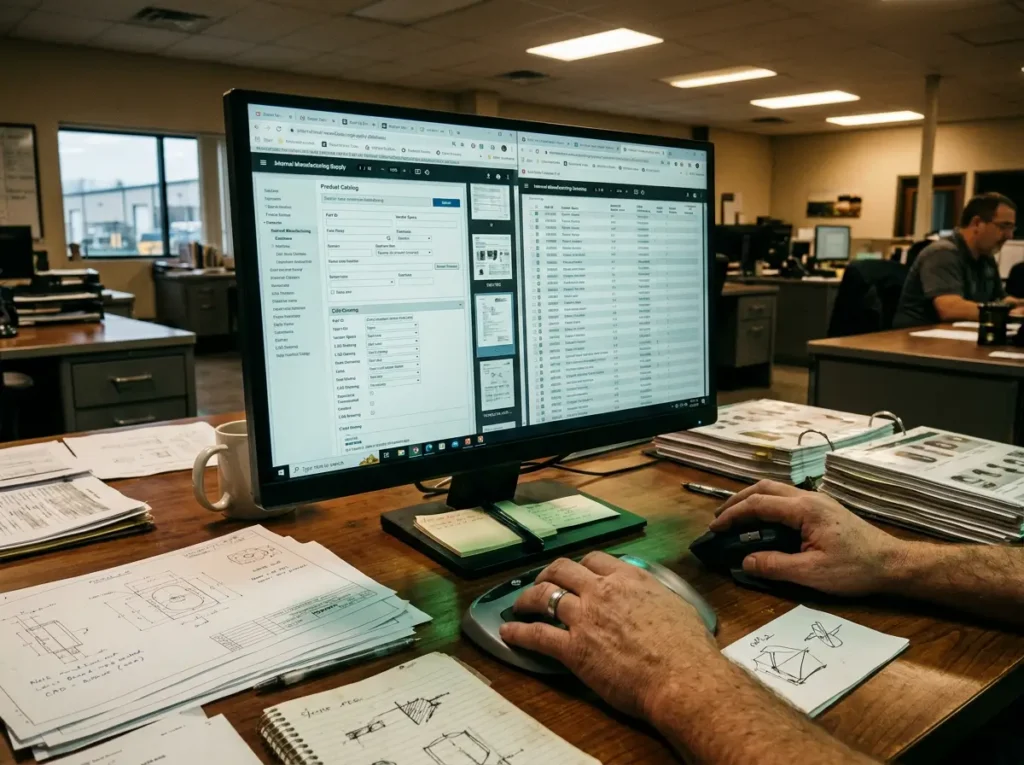
The 90s catalog aesthetic is not merely a design issue; it is a fundamental architectural failure that prevents both human buyers and machine learning algorithms from understanding your value proposition.
Feature-Dumping vs. Solution-Selling
A legacy industrial website typically lists products by arbitrary internal categories or part numbers. It assumes the buyer already knows exactly what they need. This is a fatal flaw in high-stakes B2B sales, where buyers are often searching for a solution to an engineering challenge, not a specific SKU.
Modern manufacturing website best practices dictate a shift toward solution-centric architecture. Instead of just listing “Centrifugal Pumps Series 400,” an optimized site addresses the application: “High-Viscosity Fluid Transfer Solutions for Chemical Processing.” This structural shift aligns your website with high-intent search queries and demonstrates deep industry expertise.
The Impact on AI and LLM Search Retrieval
We have entered the era of AI-assisted search. When procurement engineers use tools like ChatGPT, Perplexity, or Google’s AI Overviews to source vendors (“Find US-based precision machining companies capable of aerospace-grade titanium milling with AS9100 certification”), these systems rely on parsing structured, semantically rich web data.
A legacy website consisting of flat HTML tables and image-based text provides zero context to an LLM. An industrial website redesign must prioritize schema markup, technical SEO, and clear entity relationships. If an AI cannot seamlessly extract your capabilities, certifications, and production capacities, you will be excluded from the AI-generated vendor shortlists that will dominate the next decade of procurement. [Internal Link: SEO Strategies for Manufacturing Companies]
The Financial Impact of an Outdated Industrial Website

The cost of maintaining a legacy website is rarely quantified on a balance sheet, but the financial hemorrhage occurs across multiple operational vectors.
Invisible Vendor Cut-Offs
In enterprise procurement, risk mitigation is the primary objective. A website that is slow, unresponsive on mobile devices, or visually archaic signals a lack of modern infrastructure. Procurement teams subconsciously associate an outdated website with outdated manufacturing processes, poor quality control, and potential supply chain unreliability. This results in immediate disqualification before your engineering or sales teams can even present a proposal. The cost is not just a lost sale; it is the loss of a multi-year, million-dollar contract.
Talent Acquisition Pipeline Degradation
Beyond lead generation, an industrial website is your primary recruitment asset. The manufacturing sector is currently facing a severe skilled labor shortage. Top-tier CNC machinists, mechanical engineers, and supply chain analysts have options. If your digital presence makes your company look like a relic of the past, you will struggle to attract the innovative talent required to scale operations and maintain a competitive edge.
A Strategic Framework for Industrial Website Modernization
Executing a successful B2B industrial website redesign requires abandoning the digital brochure mindset and treating your website as a scalable, 24/7 digital sales asset. This requires a phased, strategic approach.
Stage 1: Aligning Information Architecture with Buyer Intent
Before a single line of code is written or a mockup is designed, the site’s Information Architecture (IA) must be mapped to the actual queries and pain points of your target accounts.
- Audience Segmentation: Create distinct user pathways for different personas (e.g., Procurement Officers seeking compliance and pricing; Design Engineers seeking CAD models and material tolerances).
- Taxonomy Overhaul: Restructure product and service hierarchies. Ensure that navigation is intuitive, allowing users to filter by industry application, material, certification, and technical capability.
- De-siloing Data: Integrate product databases intelligently so that users can move seamlessly from a high-level industry application page down to specific technical specifications. [Internal Link: Optimizing B2B Website Navigation]
Stage 2: Implementing Technical SEO and Semantic Depth
An authoritative design must be supported by an optimized technical foundation. This is where you future-proof the site against algorithmic shifts and AI search integration.
- Site Speed and Core Web Vitals: Industrial sites often suffer from bloated code and poorly optimized images. Replatforming to a modern CMS and optimizing server response times is non-negotiable for both Google rankings and user retention.
- Structured Data Implementation: Deploy comprehensive JSON-LD schema markup. This translates your website’s content into a language search engines natively understand, specifically tagging elements like Organization, Product, Manufacturer, and FAQPage.
- Semantic Content Clusters: Move away from thin, 300-word service pages. Develop comprehensive, long-form content clusters that cover specific engineering capabilities, material science applications, and industry-specific compliance standards. This establishes topical authority, signaling to search engines that you are the definitive expert in your niche.
Stage 3: Building Trust Through Proof-of-Capability Assets
B2B buyers require verifiable proof of your claims to mitigate risk. Your website must serve as a repository of this proof.
- High-Fidelity Visuals: Replace generic stock photography with high-quality, professional imagery and video of your actual facilities, machinery, and personnel. Show the scale of your operations.
- Ungated Technical Resources: While some high-value assets (like complex white papers) can be gated for lead capture, essential technical resources—such as compliance certificates (ISO, AS, ITAR), equipment lists, and material tolerance charts—must be readily available and crawlable by search engines.
- Detailed Case Studies: Transform generic case studies into detailed, problem-solution-result frameworks. Detail the specific engineering challenge the client faced, the precise methodology your team used to solve it, and the quantifiable operational impact (e.g., “Reduced production cycle time by 18%”).
Transitioning from Static Catalog to Lead Generation Engine
Modernizing your industrial website is not an IT project; it is a critical business development initiative. The goal is to transform a passive, digital catalog into an active lead generation engine that pre-qualifies traffic, educates decision-makers, and seamlessly routes high-intent prospects to your technical sales team.
By aligning your digital architecture with the expectations of modern procurement professionals and the technical requirements of advanced search systems, you position your firm not just as a vendor, but as an authoritative, low-risk, and highly capable industrial partner.
Frequently Asked Questions (FAQ)
Why should a manufacturing company invest in an expensive website redesign if most of our business comes from referrals? While referrals and existing relationships are foundational to industrial revenue, relying on them exclusively limits scalability and exposes you to market contraction. As older purchasing managers retire, the incoming generation of procurement professionals relies heavily on digital research to vet potential new partners. Furthermore, even referred prospects will visit your website to validate your capabilities. An outdated site can introduce doubt, causing a referred prospect to reconsider and engage with a competitor who projects a more modern, capable image.
How does migrating our legacy product catalog impact our current SEO rankings? Migrating a massive legacy catalog is the highest-risk element of an industrial website redesign. If done improperly, it can result in a catastrophic loss of organic traffic and keyword rankings. A strategic migration requires a comprehensive 301 redirect map, ensuring that every old product URL points to its exact equivalent on the new site. Additionally, this is the optimal time to consolidate duplicate or thin product pages, improving overall site architecture and consolidating link equity to boost the performance of high-value category pages.
What specific website elements do AI search engines (LLMs) look for when answering B2B procurement queries? AI search engines prioritize context, semantic relationships, and factual authority over traditional keyword density. They rely heavily on structured data (Schema markup) to understand your exact capabilities, location, and product specifications. LLMs also favor comprehensive, well-structured long-form content that directly answers complex engineering or manufacturing questions. To rank in AI-generated responses, your site must clearly articulate what you do, how you do it, the industries you serve, and the certifications you hold, using clear, unambiguous, and expertly written text.
How do we measure the ROI of an industrial website redesign beyond basic traffic metrics? Traffic volume is a vanity metric if it does not convert into pipeline revenue. The ROI of an industrial website redesign should be measured through high-intent conversion actions and pipeline velocity. Key metrics include the volume of Request for Quote (RFQ) submissions, downloads of gated technical specifications or CAD files, the quality of leads generated (measured by company size and fit), and the reduction in the sales cycle length, as a better website answers buyer questions preemptively before they ever speak to sales.
Should we gate our technical specifications and CAD files to generate more leads? Gating content is a strategic balancing act. While gating every technical document will increase top-of-funnel lead volume, it will severely frustrate the user experience for design engineers and procurement officers who need quick data to include your parts in their models. Best practice dictates leaving essential technical specs, compliance data, and basic CAD models ungated to remove friction and improve SEO crawlability. Reserve lead capture gates for high-value, proprietary assets such as in-depth engineering white papers, exclusive industry research, or specialized configuration tools.
Strategic Conclusion

Clinging to a legacy website in a highly digitized procurement landscape is an unforced error that silently drains potential revenue. Enterprise buyers are actively searching for reliable, innovative, and capable industrial partners. If your digital storefront projects obsolescence, they will take their million-dollar contracts elsewhere.
An industrial website redesign is not an aesthetic indulgence; it is a fundamental realignment of your sales infrastructure. By upgrading your digital architecture, optimizing for modern search and AI retrieval, and prioritizing the user experience of the modern B2B buyer, you establish digital authority that matches your operational excellence.
Stop losing invisible RFPs to competitors with inferior capabilities but superior digital presences. Audit your current digital footprint today, map the friction points in your buyer’s journey, and begin the strategic process of turning your website into your most effective, scalable sales asset.
Would you like me to outline a step-by-step content gap analysis to identify exactly which search queries your current website is failing to capture?