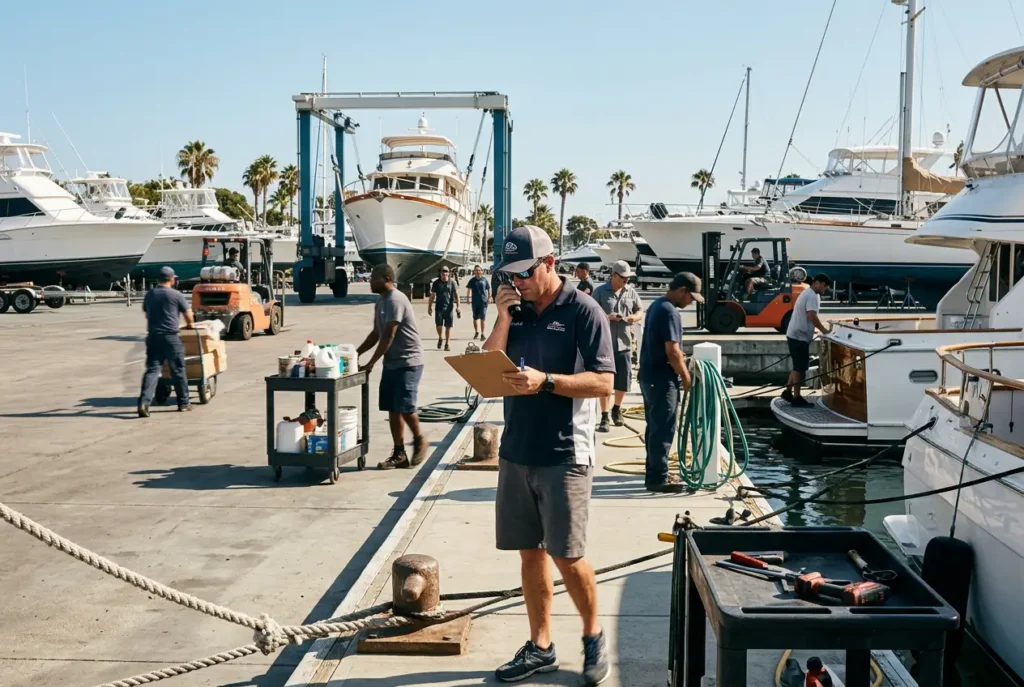
In the capital-intensive marine industry, the reflex to “scale up” often manifests as an immediate increase in top-of-funnel ad spend. Whether targeting commercial fleet operators or high-net-worth yacht buyers, the assumption is that more volume equals more revenue. However, for high-performing brands,those consistently achieving a Return on Ad Spend (ROAS) of 8:1 or higher,the strategy is the exact opposite.
Before a single dollar of additional budget is authorized, elite marine marketers address the Efficiency Gap. This is the structural divide between traffic acquisition and profitable conversion. In an era where maritime digital transformation is accelerating, simply “buying the keyword” is no longer a competitive advantage. The advantage lies in the infrastructure that receives the click.
This article analyzes the pre-scaling protocols of the industry’s top performers, focusing on the strategic shift from aggressive spending to rigorous operational and digital optimization.
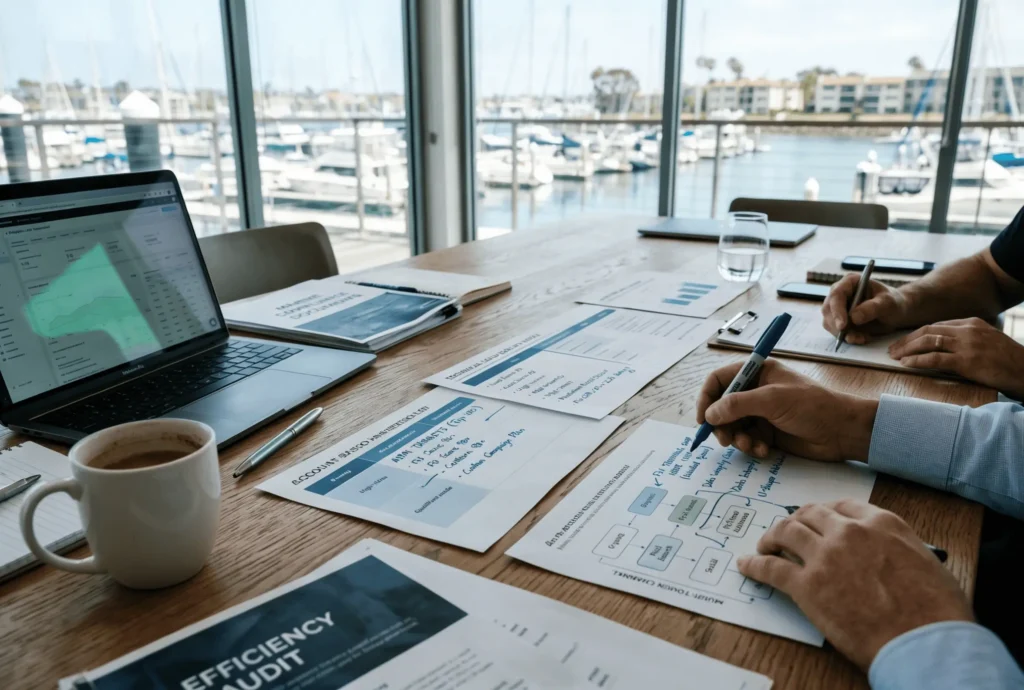
1. Establishing a Data-Driven Attribution Baseline
High-performing marine brands do not rely on “gut feel” or siloed platform data. They recognize that the maritime buyer’s journey is long, complex, and involves multiple stakeholders,from the captain and engineer to the procurement officer or C-suite executive.
Moving Beyond Last-Click Attribution
Standard Google or Meta dashboards often overvalue the final touchpoint, leading to a misallocation of funds. Leaders in the sector implement multi-touch attribution models that account for:
- Initial Research (Organic/SEO): Where the problem is identified (e.g., “IMO 2026 compliance”).
- Mid-Funnel Education (Webinars/White Papers): Where trust is built through technical expertise.
- Final Intent (Paid Search): Where the specific vendor is chosen.
The “Sunk Cost” Audit
Before scaling, these brands audit existing campaigns to identify “bleed.” If a specific geographic region or equipment category has a high Cost Per Acquisition (CPA) but low Lifetime Value (LTV), it is pruned. Scaling a broken system only scales the loss.
2. Infrastructure Hardening: Conversion Rate Optimization (CRO)
A website is not a digital brochure; it is a high-performance engine. If the site takes longer than three seconds to load, or if the mobile experience is cumbersome for a port manager on a tablet, the ad spend is effectively a donation to the platform.
Technical Performance as a Prerequisite
High-growth brands treat page speed and mobile responsiveness as marketing priorities.
- The 3-Second Rule: Studies show that a delay from 3 to 6 seconds increases bounce rates by over 100%.
- Mobile-First for On-Site Users: In the B2B marine sector, users are often on-dock or on-vessel. A “thumb-friendly” interface isn’t a luxury; it’s a conversion requirement.
High-Intent Landing Page Architecture
Generic homepages are conversion killers. High-performing brands build dedicated landing pages for specific ad groups. These pages feature:
- Above-the-Fold UVP: A clear Unique Value Proposition that answers “Why us?” in under five seconds.
- Social Proof and Technical Validation: Case studies, IMO certifications, and peer testimonials are integrated directly into the path to purchase.
- Frictionless CTA: Instead of a generic “Contact Us,” they use intent-driven prompts like “Request a Technical Specification” or “Calculate Fuel Savings.”
3. The Shift from Lead Volume to Lead Quality (ABM)
In high-value service industries, 100 unqualified leads are worth less than five high-intent prospects. High-performing brands utilize Account-Based Marketing (ABM) to align their sales and marketing efforts before increasing spend.
Strategic Tiering
Before broadening ad reach, brands identify their “Tier 1” accounts. Ad spend is then surgically applied to reach the specific decision-makers within those organizations. This prevents the “spray and pray” waste common in lower-performing competitors.
Content as an Advisory Tool
The marine industry is shifting from aggressive selling to a consultative role. Content is used to solve the prospect’s problems,such as navigating new environmental regulations or optimizing fleet maintenance cycles,long before a sales pitch is delivered.
4. Leveraging Predictive Maintenance for Marketing
Just as predictive maintenance saves millions in vessel operations, “predictive marketing” saves millions in ad spend. By analyzing historical data, brands can forecast seasonal demand and regulatory shifts.
Pre-emptive Budget Allocation
High-performers increase spend ahead of the curve,not during the peak when bidding wars drive up CPCs. For example, if data shows a spike in procurement research every October, the budget is ramped up in August to capture the early research phase.
Strategic Conclusion
The brands that dominate the maritime sector in 2026 are not those with the largest budgets, but those with the most efficient engines. Increasing ad spend is a tactical move; optimizing your conversion architecture is a strategic one. By focusing on data integrity, technical performance, and account-based precision, marine organizations can ensure that every dollar added to the budget is an investment in growth, not a cost of doing business.
FAQ Section
Why should I optimize my website before increasing my marine ad spend?
Increasing ad spend on a site with low conversion rates is an inefficient use of capital. Conversion Rate Optimization (CRO) ensures that the traffic you pay for actually moves through the sales funnel. High-performing brands prioritize page speed, mobile responsiveness, and clear value propositions to lower their Customer Acquisition Cost (CAC) before scaling.
What are the most important KPIs to monitor before scaling marine ads?
Beyond basic clicks, you must track Return on Ad Spend (ROAS), Cost Per Qualified Lead (CPQL), and the conversion rate of specific landing pages. Additionally, look at “Time to Convert.” In the marine industry, B2B sales cycles are long; understanding the velocity of your funnel helps determine if the current traffic is actually high-intent.
How does Account-Based Marketing (ABM) impact ad spend efficiency?
ABM allows marine brands to target specific high-value companies and decision-makers rather than a broad, anonymous audience. By focusing spend on accounts with the highest potential Lifetime Value (LTV), you reduce waste and ensure that your marketing budget is supporting the sales team’s most critical targets.
Is SEO more effective than paid ads for the marine industry?
It is not a matter of one being better, but how they work together. Organic search (SEO) typically offers a much higher long-term ROI (up to 748% in some B2B sectors), but it takes time to build. Paid ads provide immediate visibility. High-performing brands use SEO to build “owned” authority and use paid ads as a “rented” catalyst to capture immediate high-intent queries.
How do I know if my marine brand is ready to increase its budget?
You are ready to scale when: 1) Your tracking and attribution are accurate and verifiable. 2) Your website conversion rate is stable or improving. 3) You have identified which specific channels and keywords are driving qualified leads, not just traffic. 4) Your backend sales process can handle an increased lead volume without a drop in follow-up quality.