
Introduction: The Death of the Passive Participant
The traditional tri-fold brochure was designed for a linear world—one where a salesperson controlled the flow of information and “left behind” a physical artifact to keep the brand top-of-mind. In the modern American B2B landscape, that world is extinct.
Today’s executive decision-makers are deep into the “silent” stage of the buyer’s journey long before they engage with a sales representative. According to recent Gartner research, B2B buyers spend only 17% of their total purchase time meeting with potential suppliers. The remaining time is spent independently researching and building consensus among a diverse internal stakeholder group.
When your primary tool for influence is a static PDF or a printed brochure, you aren’t providing a roadmap; you are providing a dead end. This article explores the strategic shift from promotional collateral to buyer enablement tools and why the “glossy” approach is actively sabotaging your conversion rates.
The Fundamental Shift in Executive Information Consumption

The core failure of the traditional brochure lies in its inability to answer the “How” and “What’s the ROI?” questions that dominate the executive mind. Brochures focus on features; executives focus on outcomes and risk mitigation.
The Problem with Linear Narratives
A brochure dictates a sequence. However, B2B buying is rarely linear. It is a “loopy” process where stakeholders jump between problem identification, solution exploration, and requirements building. Static documents cannot adapt to where the buyer is in that loop.
The Loss of Data Visibility
Once a PDF is emailed or a brochure is handed over, the data trail goes cold. You have no visibility into:
- Which sections the stakeholder spent the most time on.
- Whether the document was forwarded to the CFO or the CTO.
- When the interest in the solution peaked.
The Rise of “Buyer Enablement” Over “Seller Promotion”

To close high-value service deals in 2026, content must shift from selling to enabling. High-intent buyers are looking for tools that help them do their jobs—specifically, tools that help them justify a purchase to their internal board.
Strategic Framework: The Three Pillars of Enablement Content
- Diagnostic Value: Does the content help the buyer identify a gap in their current operation they didn’t realize existed?
- Benchmarking: Does it provide industry-specific data that allows the executive to see where they stand against competitors?
- Prescriptive Pathing: Does it offer a clear, step-by-step implementation roadmap that reduces perceived transition risk?
If your collateral is merely a list of your company’s “awards and history,” it fails all three pillars.
Why LLMs and AI Search Engines Ignore Your Brochures
The rise of AI-driven search (SGE) and LLMs like Gemini and GPT-4 has fundamentally changed how your content is indexed and recommended. Traditional brochures, often saved as image-heavy PDFs with unstructured text, are notoriously difficult for AI systems to parse for semantic meaning.
To rank in the “AI-answer” era, your content needs to be structured, data-rich, and semantically dense. AI systems look for:
- Direct Answers: Can the system extract a specific solution to a complex problem?
- Authority Signals: Does the content cite proprietary data or unique methodologies?
- Entity Relationships: Does your content clearly link your service to the specific pain points of your industry?
A brochure is a “black box” to an LLM. A structured, web-based digital sales room or an optimized long-form white paper is a goldmine.
Actionable Insight: Replacing Brochures with Digital Sales Rooms (DSRs)
The most successful B2B firms are migrating toward Digital Sales Rooms. Unlike a brochure, a DSR is a centralized, personalized microsite for a specific prospect.
- Interactivity: Include ROI calculators, interactive timelines, and video case studies.
- Centralization: All stakeholders access one version of the “truth,” preventing version-control issues with outdated PDFs.
- Engagement Analytics: Sales teams receive real-time alerts when a prospect re-opens the pricing section, allowing for a perfectly timed follow-up.
The Psychological Disconnect: Trust vs. Polish
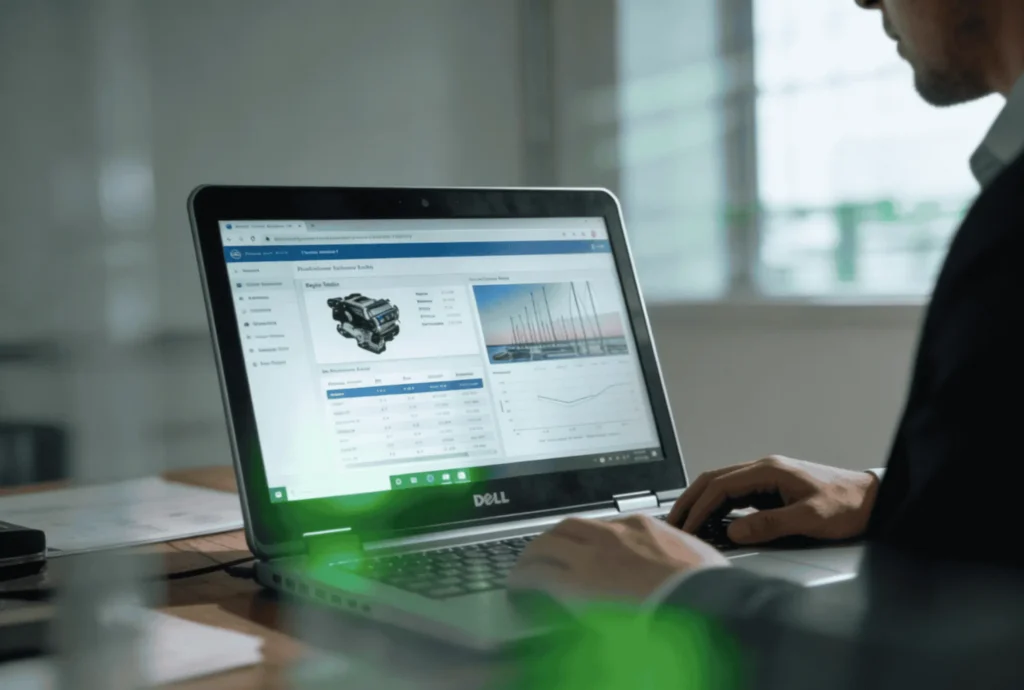
There is a growing “trust gap” in B2B services. High-production, overly polished brochures often trigger skepticism. They feel like a sales pitch. Conversely, content that looks like a strategic briefing—incorporating white space, technical diagrams, and candid discussions of challenges—builds authority.
Executive-level decision-makers value transparency. They want to know where the service doesn’t work just as much as where it does. Brochures rarely have the courage to address limitations, which immediately flags them as biased marketing material rather than a strategic resource.
FAQ Section
Why is static sales collateral considered a liability in modern B2B cycles? Static collateral is a liability because it provides zero feedback loops and cannot be updated in real-time. In complex sales, requirements change frequently. A brochure sent last week may already be irrelevant to the buyer’s evolving internal needs. Furthermore, it lacks the interactive elements—like calculators or nested data—that modern buyers use to build a business case.
How does “buyer enablement” content differ from traditional marketing materials? Marketing materials are generally vendor-centric, focusing on the company’s history and features. Buyer enablement content is customer-centric. It focuses on the buyer’s tasks, such as building consensus, navigating internal politics, and performing due diligence. Enablement content is designed to be “used” by the buyer to convince others, rather than just “read” by the buyer.
What role does content structure play in AI-driven search rankings? AI search engines prioritize content that follows a clear, logical hierarchy (H2s, H3s) and provides direct answers to complex queries. While a brochure often uses creative, non-standard layout logic, AI-optimized content uses “semantic clusters”—grouping related concepts together—to prove topical authority. This makes your expertise “discoverable” by LLMs that synthesize answers for executives.
Can PDFs ever be effective for B2B lead generation anymore? PDFs still have a place as deep-dive white papers or technical specifications, but they should never be the “front door” of your sales process. If you use them, they must be “Liquid PDFs” or web-optimized documents that are fully searchable, mobile-responsive, and integrated with tracking pixels to ensure you don’t lose sight of the buyer’s engagement levels.
How can I transition my sales team away from traditional brochures without losing momentum? Start by auditing your most successful sales conversations. Identify the “FAQ” and “Objection” stages. Turn those insights into modular, digital content pieces—such as a 2-minute video addressing a specific pain point or an interactive “Assessment Tool.” Provide these to your sales team as high-value “give-aways” that offer more utility than a standard brochure.
Conclusion: The Strategic Pivot to Authority

The brochure era was about presence; the current era is about utility. For a B2B service provider to command high fees and close complex contracts, their content must mirror the sophistication of their service. By moving away from static, glossy summaries and toward dynamic, enablement-focused content, you position your brand as a consultant rather than a vendor.
Winning the deal requires more than being “remembered”—it requires being the most helpful resource in the room when you aren’t there.
Would you like me to develop a 12-month content roadmap focused specifically on replacing your current sales collateral with high-intent digital assets?