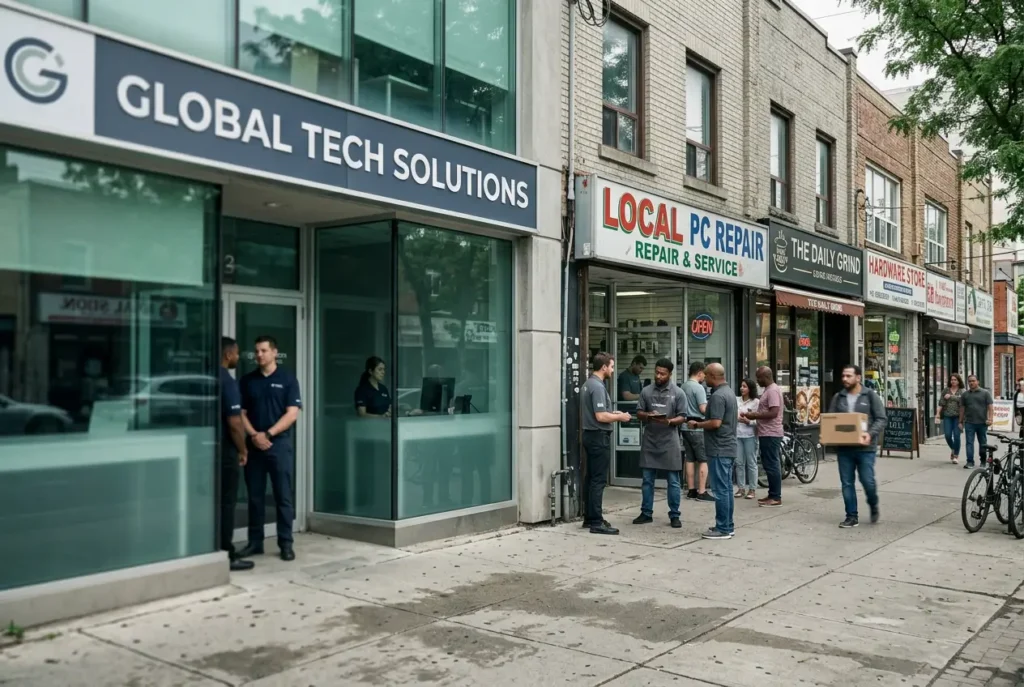
For enterprise franchises, national brand awareness frequently creates a false sense of security. Executive dashboards often highlight robust aggregate traffic, high domain authority, and top-tier rankings for broad, non-geo-modified keywords. Yet, beneath these top-line metrics lies a critical vulnerability: at the unit level, a vast majority of franchise locations remain effectively invisible in localized search results.
When a consumer searches for a specific service “near me” or within their zip code, national brand authority is secondary. The local search algorithm—whether driven by traditional Google map packs or emerging AI-assisted generative engines—prioritizes proximity, localized relevance, and entity trust. If a franchise relies solely on its corporate domain strength to drive local foot traffic or regional lead generation, it routinely loses market share to independent, single-location competitors who have mastered their immediate geographic radius.
This visibility gap is not a marketing failure; it is an architectural failure. Scaling local SEO across hundreds or thousands of distributed units requires moving beyond basic directory submissions. It requires a rigid data governance framework, a centralized command of Google Business Profiles (GBP), and highly engineered local landing pages designed for both search algorithms and Large Language Models (LLMs).
Here is the strategic blueprint for identifying why your franchise units are missing from the Local Pack and how to architect a scalable framework to reclaim local market share.
The Core Drivers of Multi-Location Invisibility

To fix local search invisibility, marketing executives must understand the structural inefficiencies that plague distributed service brands. The “80% invisibility” metric typically stems from three systemic failures in local data management.
1. Fractured Google Business Profile (GBP) Architecture
The most common cause of local invisibility is decentralized or mismanaged Google Business Profiles. In many franchise networks, GBP ownership is chaotic. Some profiles are claimed by corporate, others by individual franchisees, and some are managed by legacy third-party agencies. This fractured ecosystem leads to orphaned listings, duplicate profiles, and rogue updates.
When Google’s algorithm detects conflicting data or a lack of verification hierarchy, it diminishes the trust score of the local entity. If a franchisee alters their business hours, primary category, or business name to include keyword-stuffed modifiers (e.g., adding “Best Plumber” to the official brand name), the corporate entity risks account-wide suspensions. Without a centralized Google Agency account utilizing Location Groups to enforce data standardization, corporate marketers are effectively flying blind.
2. The Thin Content Problem on Location Pages
Many enterprise franchises utilize a basic “store locator” widget or dynamically generated location pages that offer little to no unique value. A URL structure like brand.com/locations/?id=4592 populated with boilerplate copy, a map, and basic contact information is insufficient for competitive local SEO.
Search engines view these template-driven pages as thin content. To rank a specific franchise unit against a specialized local competitor, the location page must act as a comprehensive localized asset. It requires unique, localized service descriptions, geo-specific trust signals (local reviews, regional credentials), and distinct metadata. When 500 franchise pages feature the exact same 400 words of corporate marketing copy, the search engine has no semantic reason to rank the local page for a specific geographic query.
3. Unstructured and Inconsistent Spatial Data
Name, Address, and Phone number (NAP) consistency remains a foundational pillar of local entity resolution. For franchises, NAP data frequently degrades over time. Franchisees move locations, change local phone numbers, or update their hours without notifying corporate. This creates a fragmented data footprint across primary data aggregators (Data Axle, Foursquare, Localeze) and Tier 1 directories (Apple Maps, Bing, Yelp).
When LLMs and search algorithms cross-reference a franchise location to verify its legitimacy, conflicting spatial data introduces friction. In the local search ecosystem, algorithmic confusion translates directly to a drop in rankings.
Architecting a Scalable Franchise SEO Framework
Resolving the visibility gap requires a shift from tactical, location-by-location SEO to programmatic, enterprise-scale architecture.
Centralized Governance vs. Decentralized Execution

The most successful franchise SEO models operate on a principle of centralized data governance paired with localized content execution.
Corporate marketing must control the foundational data. This means utilizing enterprise API integrations to manage GBP data, aggregate syndication, and core NAP consistency from a single source of truth. Individual franchisees should never have primary ownership of their GBP assets; they should be granted manager access to respond to reviews and post local updates, strictly within corporate brand guidelines.
Conversely, content execution should leverage local knowledge. While the technical architecture is centralized, corporate teams must build intake systems allowing franchisees to submit localized content—such as regional case studies, photos of local projects, and community involvement—to enrich their specific location pages.
Engineering High-Performance Local Landing Pages
A high-ranking franchise location page requires a specific technical and structural anatomy.
First, the URL architecture must follow a logical, hierarchical path: brand.com/locations/state/city/store-name. This establishes a clear semantic relationship for search engine crawlers.
Second, the page must deploy robust LocalBusiness Schema markup. This JSON-LD code should explicitly state the business type, geo-coordinates, operating hours, local phone number, and aggregate review ratings. For franchises, it is critical to use the parentOrganization or department properties within the schema to clearly define the relationship between the local unit and the corporate entity.
Third, the page must integrate localized proof of work. This includes embedding reviews specific to that exact unit, listing the local staff or operators, and detailing the exact service areas covered by that franchise territory.
Managing Reputation at Scale: The Velocity and Sentiment Factors
In local search, reviews are not just conversion mechanisms; they are primary ranking factors. The algorithm analyzes review volume, review velocity (how consistently new reviews are generated), and review sentiment.
Franchises often struggle because they lack a programmatic way to generate reviews at the unit level. A location with three reviews from 2021 will not outrank a local competitor generating two new reviews every week. Enterprise executives must implement automated, post-service review generation campaigns that route customers to the specific GBP of the location they visited. Furthermore, incorporating sentiment analysis tools across the network allows corporate to identify operational failures at the unit level before they permanently damage the local entity’s search visibility.
Optimizing for AI Search Systems (LLMs) in the Franchise Space

The introduction of AI Overviews, Search Generative Experience (SGE), and standalone LLMs (like Perplexity or ChatGPT) is fundamentally altering how consumers find local services. Optimizing a franchise network for generative AI requires a distinct layer of strategy beyond traditional local SEO.
LLMs do not merely crawl blue links; they synthesize entities based on consensus across the web. When a user asks an AI, “What is the most reliable commercial HVAC company in Austin, Texas?”, the LLM relies heavily on sentiment analysis, structured data, and authoritative mentions across independent platforms.
To ensure your franchise units are recommended by AI systems, you must optimize for entity density. This means the local franchise must be discussed contextually across the web, not just listed in directories. High-quality digital PR for local units, consistent mentions in regional business journals, and highly structured, scannable data on the location page (using clear H2s and H3s that directly answer consumer questions) are essential. AI engines extract localized answers faster when the local landing page is structured to provide direct, factual, and easily parsed information.
FAQ: High-Intent Franchise Local SEO Queries
How do we manage Google Business Profiles across hundreds of franchise locations securely?
Managing multi-location GBPs requires establishing a Google Agency Account and utilizing Location Groups (formerly business accounts). Corporate marketing must maintain primary ownership of the master account, grouping locations logically (e.g., by state or region) to manage user permissions efficiently.
Franchisees or regional managers should only be granted “Manager” access. This allows them to respond to reviews and publish local posts without giving them the administrative rights to alter the core NAP data, change the primary business category, or inadvertently trigger a profile suspension. Utilizing an enterprise local SEO platform that connects to the GBP API is highly recommended to push bulk updates, such as holiday hours, simultaneously across the network.
Should franchisees have their own independent websites or local pages on the corporate domain?
Franchisees should almost never have independent websites. Splitting franchise units onto separate domains dilutes your brand’s overall domain authority and creates a competitive nightmare where franchisees are often competing against the corporate site—and each other—in the search results. It also leads to massive inconsistencies in brand messaging and security protocols.
The superior strategy is to host all locations on the primary corporate domain utilizing a robust sub-folder architecture (e.g., brand.com/locations/dallas). This allows every local unit to benefit from the aggregate link equity and authority of the national corporate site, while still providing a dedicated, highly relevant page to rank for geo-modified local searches.
How does corporate domain authority impact local map pack rankings?
While high corporate domain authority (DA) significantly aids in ranking traditional organic “blue links,” its impact on the Local Map Pack is secondary to proximity, relevance, and GBP prominence. A powerful corporate domain can pass valuable link equity to a local landing page, which in turn acts as the linked website on the Google Business Profile, providing a moderate boost in prominence.
However, if the local GBP is poorly optimized, lacks recent reviews, or features inconsistent NAP data, a high corporate DA will not save it. The Local Pack algorithm operates on a separate set of priorities, emphasizing the geographic validity of the specific entity over the overall backlink profile of the parent company.
What is the fastest way to resolve NAP inconsistencies across a legacy franchise network?
The most efficient method to clean up legacy data fragmentation is through an enterprise-grade data aggregator and syndication service. Rather than manually updating hundreds of directories for each location, these platforms allow corporate teams to establish a single source of truth for all location data.
This centralized data is then pushed via API to primary aggregators and Tier 1 directories, overwriting conflicting legacy data. However, syndication alone is not a silver bullet; teams must also conduct manual audits for duplicate Google Business Profiles and localized duplicate directory listings, as these often require manual closure or merging to fully resolve algorithmic confusion.
Strategic Conclusion

The invisibility of franchise locations in local search is a systemic issue rooted in decentralized data, thin content architecture, and a misunderstanding of local ranking algorithms. Relying on national brand equity to drive unit-level foot traffic or lead generation is a strategy with diminishing returns, particularly as AI-driven search engines prioritize hyper-local relevance and verifiable entity trust.
By centralizing data governance, engineering robust localized landing pages, and enforcing a programmatic approach to review generation, executive leaders can transform their local search footprint from a liability into a scalable acquisition channel. The brands that master multi-location SEO architecture will dominate the Local Pack, leaving disorganized competitors invisible to the highest-intent consumers in their markets.