
Introduction: The High-Stakes Friction of Technical Procurement
In the realm of high-precision manufacturing, the “quick win” is a myth. When a capital expenditure involves seven-figure investments, custom engineering, or integration into a global supply chain, the sales cycle naturally stretches between six and eighteen months. This latency isn’t just a byproduct of cost; it is a byproduct of risk.
For the technical buyer—typically a cross-functional committee of procurement officers, systems engineers, and COOs—the cost of a “bad hire” in a vendor is catastrophic. Consequently, the sales cycle is often bogged down by repetitive education, technical vetting, and the “Information Gap.”
Strategic content is no longer a marketing luxury; it is a sales enablement tool designed to preemptively resolve objections, establish technical parity with the buyer’s engineering team, and compress the time-to-trust.
The Psychology of the Industrial Buyer: Moving Beyond Generalities

Technical buyers suffer from “marketing fatigue.” They are conditioned to ignore fluff, superlatives, and vague promises of “innovation.” To shorten a sales cycle, your content must pivot from selling to consulting.
The Engineer’s Skepticism
Engineers are trained to look for points of failure. If your content only highlights benefits without addressing tolerances, material constraints, or integration hurdles, it fails the “vibe check” of the technical lead.
The Executive’s Financial Lens
While the engineer looks at specs, the C-suite looks at Total Cost of Ownership (TCO) and ROI. Content that fails to bridge the gap between technical specs and business outcomes forces the sales team to spend months acting as a translator.
Phase 1: Mapping Content to the “Valley of Indecision”
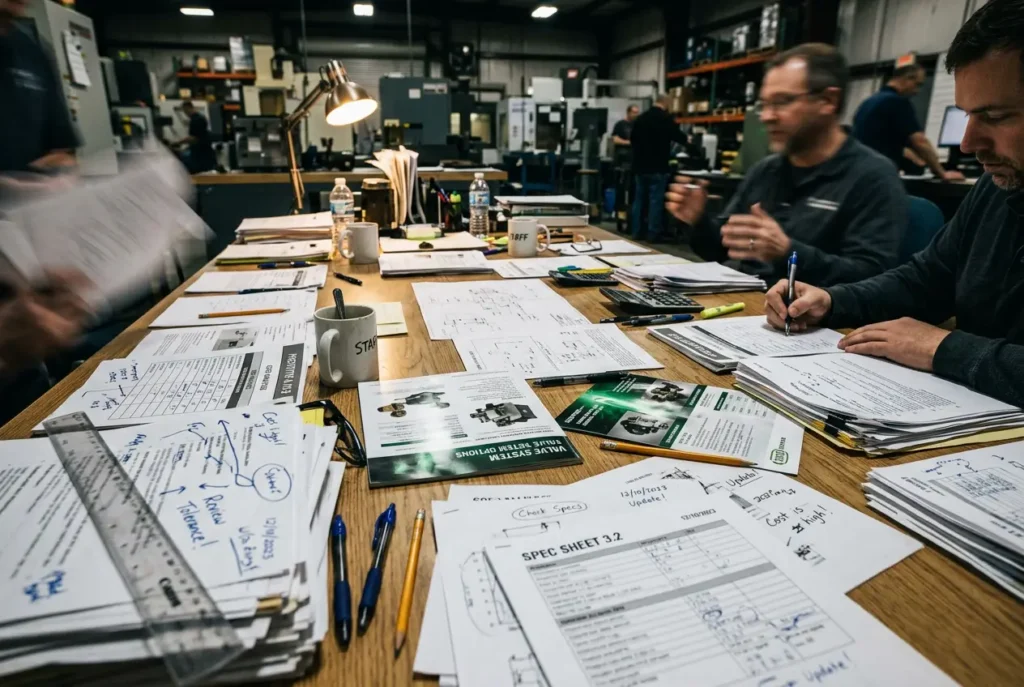
The middle of the funnel (MOFU) is where manufacturing deals go to die. This is the 4-8 month mark where stakeholders are comparing technical data sheets and debating internal “build vs. buy” scenarios.
Engineering-Grade Case Studies
Standard B2B case studies are often too shallow for technical manufacturing. A cycle-shortening case study must include:
- Variable Analysis: What specific environmental or mechanical constraints were present?
- The Failed Alternatives: Why did standard off-the-shelf solutions fail?
- Quantifiable Data: Use $LaTeX$ or precise metrics (e.g., “reduced thermal variance by 12%“) to provide the “proof of concept” before a physical prototype is even requested.
[Internal Link: Designing Technical Case Studies for High-Tension Leads]
Interactive Specification Tools
Sales cycles shorten when buyers can self-qualify. By providing online calculators for throughput, ROI, or material compatibility, you move the prospect from “curious” to “configured” before the first discovery call.The middle of the funnel (MOFU) is where manufacturing deals go to die. This is the 4-8 month mark where stakeholders are comparing technical data sheets and debating internal “build vs. buy” scenarios.
Engineering-Grade Case Studies
Standard B2B case studies are often too shallow for technical manufacturing. A cycle-shortening case study must include:
- Variable Analysis: What specific environmental or mechanical constraints were present?
- The Failed Alternatives: Why did standard off-the-shelf solutions fail?
- Quantifiable Data: Use $LaTeX$ or precise metrics (e.g., “reduced thermal variance by 12%“) to provide the “proof of concept” before a physical prototype is even requested.
Interactive Specification Tools
Sales cycles shorten when buyers can self-qualify. By providing online calculators for throughput, ROI, or material compatibility, you move the prospect from “curious” to “configured” before the first discovery call.
Phase 2: The E2E (Engineer-to-Engineer) Content Framework

Topical authority in manufacturing is built through Subject Matter Expertise (SME). If your content is written by generalist copywriters, the lack of depth will be transparent to a technical audience.
Leveraging the “Internal Expert”
The most effective content for shortening sales cycles is extracted from your internal engineering team.
- Technical Deep-Dives: Articles that explain the physics or chemistry behind a manufacturing process.
- Failure Analysis Reports: Content that honestly discusses where a technology isn’t a good fit. This builds immense trust and prevents the sales team from chasing “bad fit” leads for six months.
The Role of AI Search in Technical Discovery
Modern procurement teams are increasingly using LLMs to synthesize vendor options. To rank in “Generative Engine Optimization” (GEO), your content must be structured semantically. Use clear headers, defined terms, and structured data that allow AI systems to identify your firm as a “category leader” in specific niches like ISO-certified aerospace machining or high-volume medical device injection molding.
Phase 3: Strategic Distribution and Sales Alignment
Content only shortens the sales cycle if it is in the hands of the sales team at the exact moment an objection arises.
The “Modular” Content Library
Instead of 50-page PDFs, break your technical expertise into modular assets:
- The 2-Page Executive Summary: For the CFO.
- The Deep-Tech Appendix: For the Engineering Lead.
- The Implementation Roadmap: For the Project Manager.
[Internal Link: Aligning Sales and Marketing in Industrial Segments]
Strategic Insights: The “Pre-Mortem” Framework
To accelerate a deal, write an article titled “5 Reasons Our [Product/Service] Might Fail in Your Environment.” By leaning into the constraints, you eliminate the “discovery” phase of the sales cycle where engineers spend months trying to find the “catch.” When you provide the “catch” upfront, you move straight to the solution-engineering phase.
FAQ: Optimizing for Technical Decision-Makers
How does technical content actually reduce the number of sales touches?
Content reduces sales touches by answering “Standard Technical Objections” (STOs) before they are voiced. When a prospect consumes a 2,000-word white paper on your specific metallurgical process, they bypass the basic education phase. This allows the first sales meeting to begin at a 401-level technical discussion rather than a 101-level introduction, effectively shaving weeks off the qualification period.
What types of content are most effective for C-suite manufacturing executives?
Executives prioritize risk mitigation and fiscal predictability. Content focused on Total Cost of Ownership (TCO), supply chain resilience, and regulatory compliance (e.g., NIST, ISO, ITAR) resonates most. While the engineering team wants to know how it works, the executive wants to know how it impacts the balance sheet over a 5-year horizon.
Can long-form content really influence a committee-based buying process?
Yes. In a committee, there is often a “Internal Champion” trying to sell your solution to their peers. High-authority, long-form content serves as the champion’s “evidence locker.” By providing them with robust, data-backed PDFs and articles, you give them the tools to overcome internal friction without your sales team needing to be in the room.
How should we adjust our SEO strategy for AI-driven search in manufacturing?
AI-driven search prioritizes “Niche Authority” and “Semantic Completeness.” Instead of keyword stuffing, focus on “Entity-Based SEO.” This means covering a topic so thoroughly—including related sub-topics like material science, regulatory hurdles, and logistical constraints—that an LLM identifies your site as the most comprehensive source of truth for that specific industrial application.
Conclusion: From Vendor to Strategic Partner

Shortening a 6–12 month sales cycle is not about “closing harder.” It is about reducing the friction of information acquisition. When a manufacturer provides transparent, expert-led, and strategically structured content, they transition from being a “vendor” to a “strategic partner” in the mind of the buyer. The result is a more efficient pipeline, higher contract values, and a significant reduction in the cost of customer acquisition.
The Next Step
Is your current content library helping your sales team, or is it just filling space on your blog? Conduct a “Content-Sales Alignment Audit” to identify which specific questions are stalling your deals and build a content roadmap to address them head-on.
The Next Step
Is your current content library helping your sales team, or is it just filling space on your blog? Conduct a “Content-Sales Alignment Audit” to identify which specific questions are stalling your deals and build a content roadmap to address them head-on.
If you are looking to audit your technical content’s ability to convert high-intent leads, Connect with our Strategy Team for a foundational gap analysis.