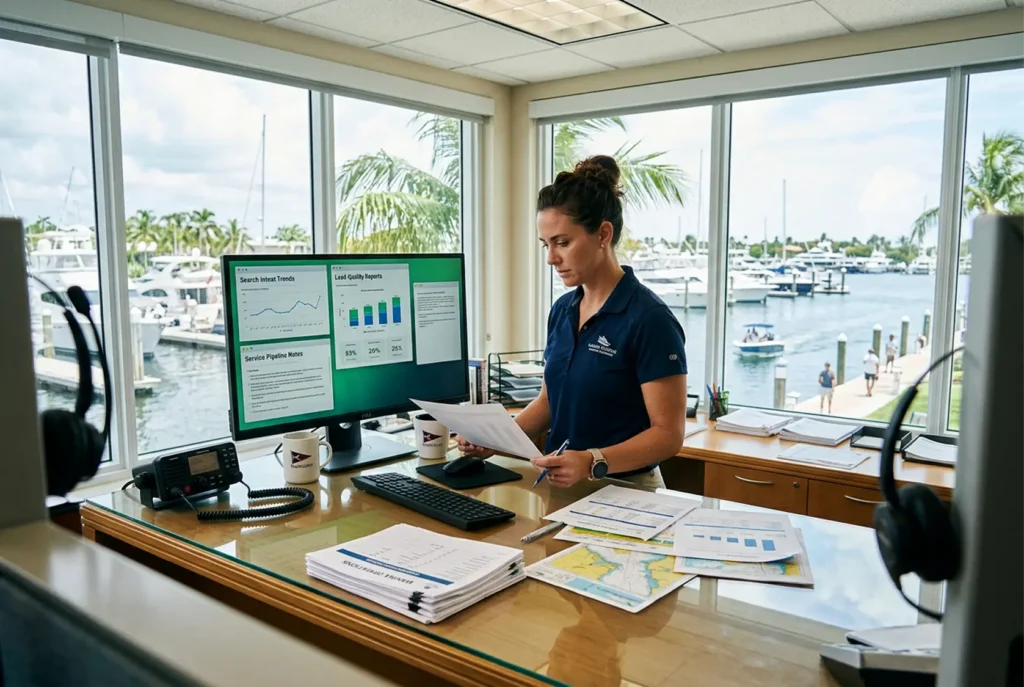
For marine service providers,ranging from specialized hull maintenance firms to complex engine refit facilities,the traditional business model is often plagued by volatility. Many operators rely heavily on seasonal surges, word-of-mouth, and reactive marketing. While these channels are foundational, they lack the mathematical predictability required for aggressive scaling or stabilizing year-round operations.
The shift toward a predictable booking pipeline requires a transition from “visibility” to “intent-alignment.” In a high-stakes industry where a single repair contract can range from $5,000 to over $500,000, understanding the digital breadcrumbs left by vessel owners and fleet managers is the ultimate competitive advantage. By leveraging search intent data, marine companies can identify high-value leads at the precise moment a “need” transforms into a “search.”
The Hierarchy of Search Intent in the Maritime Sector
To build a data-driven pipeline, one must first categorize how potential clients search. Not all traffic is created equal; high-volume keywords often yield low-value leads.
1. Informational Intent (Top of Funnel)
Users are looking for answers to maintenance queries (e.g., “how often to replace zinc anodes”). While these users aren’t ready to book today, capturing this data allows service companies to build topical authority and brand recall.
2. Investigatory Intent (Middle of Funnel)
This is where the decision-maker compares solutions (e.g., “ultrasonic vs. traditional hull cleaning”). Data at this stage reveals the specific pain points the market is feeling,whether it’s fuel efficiency concerns or regulatory compliance.
3. Transactional/Commercial Intent (Bottom of Funnel)
These are “hand-raiser” queries (e.g., “emergency yacht engine repair Fort Lauderdale”). This intent data is the highest priority for immediate pipeline filling, as it signals a high urgency and a ready budget.
Strategic Framework: Mapping Intent Data to Service Offerings

A predictable pipeline is built by matching specific data signals to your highest-margin services. This requires a three-pillar framework.
Phase I: Signal Identification and Keyword Clustering
Modern SEO for the marine industry isn’t about single keywords; it’s about clusters. If your firm specializes in Volvo Penta engine overhauls, your data strategy must encompass the part numbers, common failure symptoms, and regional compliance standards associated with that specific brand.
By analyzing search volume for “symptoms” (e.g., “black smoke from marine diesel engine”), a service provider can position their expertise before the client even knows they need a full overhaul.
Phase II: The “Service-Intent” Matrix
Create a matrix that aligns your service capacity with search trends.
- Predictive Maintenance: Target “preventative” search terms 60 days before the peak season begins.
- Emergency Services: Focus on geo-fenced, high-intent mobile search terms.
- Refit/Capital Projects: Focus on long-tail, technical queries that indicate a long-term planning phase.
Phase III: Reducing Friction in the Conversion Path
Search intent data tells you what the client wants. If the data shows a high volume of searches for “yacht refit pricing,” but your website forces a user to call a representative just to get a ballpark figure, you are creating friction. Addressing intent means providing the level of detail the searcher expects.
Optimizing for AI Discovery: The New Maritime SEO
Search is changing. Generative AI engines (like Perplexity or Gemini) and LLM-based search tools now act as “concierges” for busy executives. To rank within these systems, marine service providers must move away from thin content and toward semantic depth.
AI systems value:
- Technical Specificity: Mentioning specific vessel classes (e.g., “70-foot motor yachts”) or engine models.
- Entity Association: Linking your brand to established maritime hubs and industry standards.
- Structured Data: Using Schema markup to help AI understand your service area, hours, and certifications.
Actionable Insight: Leveraging Data to Stabilize Off-Season Revenue
The most significant drain on marine service profitability is the “off-season” lull. Intent data allows firms to pivot their pipeline focus. During low-activity months, the data strategy should shift toward capital-intensive upgrades and compliance-driven maintenance.
By analyzing historical search trends, companies can identify when owners begin researching “winterization” or “pre-season hull prep.” Proactively launching content and targeted campaigns 30 days ahead of these data spikes ensures your company is the first-to-mind when the demand peak hits.
Strategic Conclusion: Data as the Anchor of Growth
Predictability in the marine service industry is not a matter of luck; it is a matter of alignment. By shifting your digital strategy to focus on search intent data, you stop “fishing in the dark” and start positioning your firm exactly where the most valuable prospects are looking. In an era where AI-driven search is becoming the norm, those who provide the most depth and demonstrate the clearest understanding of client intent will dominate the harbor.
Ready to Stabilize Your Booking Pipeline?
Identifying your primary intent signals is the first step toward a recession-proof marine business. By auditing your current search presence, you can find the gaps where your competitors are leaving high-value contracts on the table.
FAQ Section
How does search intent data differ from standard keyword research for marine services?
Standard keyword research focuses on volume,how many people are searching for a term. Search intent data focuses on the “why” behind the query. For a marine service provider, a high-volume keyword like “boats” is useless. However, a lower-volume term like “MTU 2000 series cylinder head repair” carries high commercial intent. Intent data allows you to prioritize quality over quantity, ensuring your sales team spends time on leads that have a high probability of conversion.
Can small marine service firms compete with large shipyards using this strategy?
Yes. In fact, smaller firms often have an advantage in “niche authority.” Large shipyards often target broad, general terms. A specialized firm can use intent data to dominate specific niches,such as “specialized fiberglass delamination repair” or “marine electronics integration for sportfishers.” By owning the semantic space around a specific service, a smaller firm can outrank a larger competitor for the specific high-value queries that matter most.
How long does it take to see a return on an intent-based SEO strategy?
While SEO is a long-term play, an intent-based approach often yields faster “quality” results than traditional methods. Because you are targeting users who are already in the decision-making or “problem-aware” phase, the leads generated are often ready to convert. Typically, firms see an increase in lead quality within 3 to 4 months, with significant pipeline predictability manifesting within 6 to 12 months as topical authority grows.
What is the most common mistake marine companies make with their digital pipeline?
The most common mistake is failing to differentiate between “educational” and “transactional” content. Many firms spend their entire budget on “look at this beautiful boat” social media content (which is top-of-funnel and low-intent) while neglecting the technical, search-driven content that solves a specific problem. If your website doesn’t answer the technical questions a captain or owner is asking during a crisis, you aren’t building a predictable pipeline; you’re just running a digital brochure.
How do I measure the ROI of intent-based content?
ROI should be measured by Customer Acquisition Cost (CAC) and Pipeline Velocity. Track how many users who landed on a “high-intent” blog post eventually filled out a quote request. Additionally, look at the “assisted conversion” value,did a client read an article on engine maintenance before calling for a refit? By using UTM parameters and CRM integration, you can attribute high-value contracts directly to the intent-driven content that initiated the relationship.