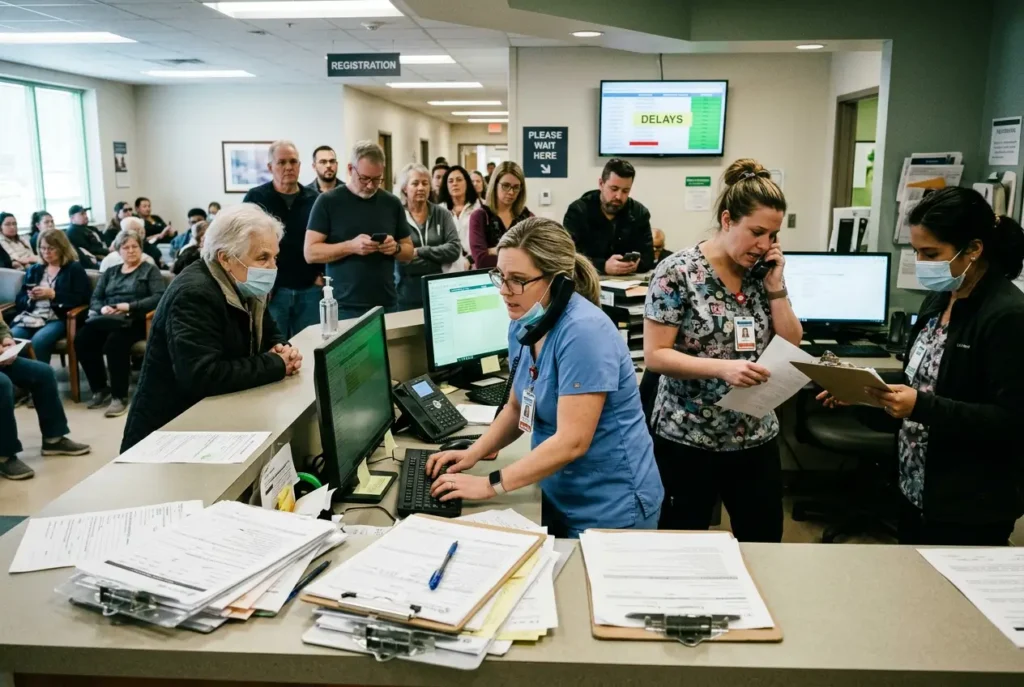
For medical groups, hospital systems, and specialized clinics, the revenue cycle does not begin in the billing department—it begins the moment a patient schedules an appointment and initiates the intake process. Despite significant investments in clinical technology and electronic health records (EHRs), the administrative front end remains a primary source of unrecognized financial loss.
Medical intake revenue leakage refers to the capital lost, delayed, or absorbed by operational inefficiencies during patient registration, insurance verification, and data collection. Executive leadership often views patient intake as a purely administrative function. However, from a financial perspective, it is the most critical chokepoint in the revenue cycle. When intake protocols rely on fragmented software, manual data entry, and paper-based workflows, the result is a compounding cascade of claim denials, staff productivity losses, and patient attrition.
To protect profit margins in an era of declining reimbursements and rising operational costs, healthcare executives must shift their focus toward the front end. This analysis provides a structured framework for quantifying the financial drain of legacy medical intake processes and outlines strategic interventions to plug these revenue leaks.
The Anatomy of Medical Intake Revenue Leakage
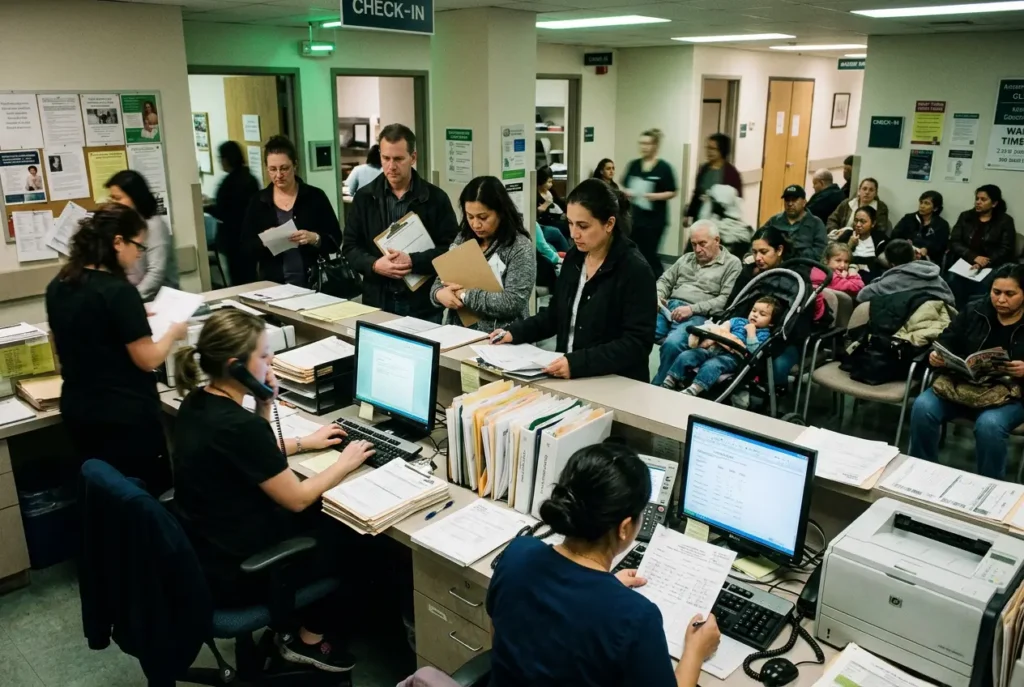
Revenue leakage at the point of intake is rarely a single, catastrophic failure. Rather, it is the sum of micro-inefficiencies that drain profitability over the fiscal year. To accurately quantify this loss, operational leaders must categorize the leakage into three core domains: claim denials, operational overhead, and patient economics.
1. Front-End Claim Denials and Demographic Errors
The most direct and measurable consequence of inefficient medical intake is the front-end claim denial. Industry data consistently indicates that up to 40% of all claim denials are rooted in front-end errors, specifically related to patient registration and eligibility.
When reception staff manually transcribe data from paper forms or verbally collect insurance information, the probability of keystroke errors, transposed numbers, or outdated policy details increases exponentially. Even minor discrepancies between the submitted claim and the payer’s database will trigger a rejection. The financial impact here is twofold: the delayed cash flow of the initial denial and the administrative cost of reworking the claim.
2. The Cost of Manual Data Entry and FTE Allocation
Healthcare organizations frequently misallocate highly trained administrative staff to low-value, repetitive tasks. When patients complete intake paperwork in the waiting room, front-desk personnel must spend substantial time deciphering handwriting, scanning documents, and manually entering demographic and clinical histories into the EHR.
This operational bottleneck represents a severe misallocation of Full-Time Equivalent (FTE) hours. Instead of focusing on patient experience, collections, or proactive scheduling, staff are trapped in data transcription. The cost of this leakage is calculated by analyzing the hourly wages absorbed by redundant administrative tasks minus the theoretical output of optimized staff.
3. Patient Abandonment and the Economics of Attrition
The modern healthcare consumer expects a digital, frictionless experience comparable to other high-value service sectors. When confronted with repetitive paperwork, extended waiting room delays, and redundant questioning, patient satisfaction plummets.
Friction in the intake process directly correlates with higher no-show rates and patient abandonment. For high-revenue specialty practices, a single abandoned appointment or late cancellation represents thousands of dollars in lost top-line revenue. Furthermore, negative intake experiences diminish patient retention rates, eroding the lifetime value (LTV) of the patient base.
A Framework for Quantifying the Financial Drain

To justify capital expenditure on digital patient intake systems or operational restructuring, executives must define the precise dollar amount of their current leakage. The following frameworks allow leadership to quantify these hidden costs accurately.
Formula 1: Calculating the Cost of Claim Rework
To measure the financial impact of front-end denials, practices must calculate the annual cost of claim rework caused specifically by registration errors. According to industry benchmarks, the cost to rework a single denied claim ranges from $25 to $30 in staff time and resources.
- Step 1: Identify the total number of claims filed annually.
- Step 2: Determine the percentage of claims denied due to registration, demographic, or eligibility errors (e.g., 8%).
- Step 3: Multiply the number of front-end denials by the average cost to rework a claim ($25).
Example Scenario: A multi-provider clinic processes 100,000 claims annually. If 8% of these claims (8,000) are denied due to intake errors, and the rework cost is $25 per claim, the annual revenue leakage from this single vector is $200,000.
Formula 2: Measuring the Cost of Wasted FTE Hours
Manual intake processing requires staff time that could be allocated to revenue-generating activities. To calculate this leakage:
- Step 1: Calculate the average time spent manually entering intake data per patient (e.g., 8 minutes).
- Step 2: Multiply this by the total number of annual patient visits (e.g., 50,000 visits).
- Step 3: Divide by 60 to find total wasted hours (6,666 hours).
- Step 4: Multiply the total wasted hours by the average hourly compensation (including benefits) of the front-desk staff (e.g., $25/hour).
Example Scenario: Processing 50,000 patients manually at 8 minutes each results in 6,666 wasted hours. At an operational cost of $25 per hour, the practice is leaking $166,650 annually in non-optimized labor costs.
Formula 3: Quantifying the Impact of No-Shows and Late Starts
When intake bottlenecks cause physicians to run behind schedule, the practice sees fewer patients per day. Additionally, intake friction contributes to no-shows.
- Step 1: Identify the average revenue per patient visit.
- Step 2: Determine the number of appointments lost per week due to intake-related scheduling delays or no-shows.
- Step 3: Multiply the lost appointments by the average revenue per visit, then annualize the figure.
Strategic Interventions to Plug Intake Revenue Leaks

Once the financial impact of medical intake revenue leakage is quantified, leadership must implement systemic, technology-driven interventions. The goal is to shift from reactive data collection to proactive, automated patient pre-registration.
1. Implement Mobile-First, Pre-Registration Workflows
Moving the intake process out of the waiting room and onto the patient’s personal device prior to the appointment is the most effective way to eliminate bottlenecks. By sending automated, secure links via SMS or email days before the visit, patients can complete demographics, clinical histories, and consent forms on their own time. This drastically reduces waiting room congestion, ensures data is captured accurately by the patient themselves, and allows the practice to review information prior to the physical encounter.
2. Deploy Automated Insurance Eligibility Verification
To combat the 40% of denials caused by front-end errors, practices must eliminate manual insurance verification. Modern intake platforms utilize direct clearinghouse integrations to automatically run eligibility checks the moment a patient schedules an appointment or completes pre-registration.
If coverage is inactive, a deductible has not been met, or a specific procedure requires prior authorization, the system flags the issue days before the patient arrives. This allows staff to intervene, correct demographic data, or collect necessary payments upfront, effectively stopping the claim denial before it occurs.
3. Mandate Bi-Directional EHR Integration
A digital intake tool is only as valuable as its ability to communicate with the core Electronic Health Record (EHR) or Practice Management (PM) system. Standalone systems that require staff to manually export and import PDFs still constitute revenue leakage. Executive teams must require bi-directional integration, ensuring that discrete data fields (allergies, medications, demographics) flow directly from the patient’s digital intake form into the corresponding fields within the EHR without human intervention.
4. Optimize Point-of-Service (POS) Collections
When financial responsibility is opaque, patients are less likely to pay post-visit balances, leading to high bad-debt write-offs. Optimizing the intake process involves presenting patients with clear, accurate estimates of their co-pays, deductibles, and out-of-pocket costs during pre-registration. By integrating secure, digital payment gateways into the intake flow, practices can capture credit card information on file and increase point-of-service collections, significantly accelerating cash flow.
Frequently Asked Questions (FAQ)
What is the primary cause of revenue leakage in the medical intake process? The leading cause of intake-related revenue leakage is manual data entry. Relying on paper forms and human transcription leads to demographic errors, outdated insurance information, and subsequent front-end claim denials. It also absorbs thousands of hours of administrative staff time that could be allocated to revenue-generating tasks.
How much do front-end claim denials cost a medical practice? Industry benchmarks indicate that reworking a denied claim costs a practice between $25 and $30 per instance in administrative overhead. Beyond the rework cost, delayed reimbursements negatively impact cash flow, and a percentage of denied claims are ultimately written off as uncollectible bad debt.
How does digital patient intake improve point-of-service (POS) collections? Digital intake platforms allow practices to run automated insurance verification before the patient arrives, calculating exact co-pays and deductible balances. By presenting this financial responsibility transparently during digital pre-registration and offering integrated payment gateways, practices can collect balances upfront before clinical services are rendered.
What does “bi-directional integration” mean for patient intake? Bi-directional integration means the digital intake software and the Electronic Health Record (EHR) system can read and write data to each other seamlessly. When a patient updates their medical history or demographics on an intake app, the specific data fields in the EHR are automatically populated in real time, entirely eliminating the need for staff to manually transcribe or scan documents.
What is the typical ROI timeline for implementing automated patient intake software? For mid-to-large practices, the return on investment is typically realized within 3 to 6 months. The immediate ROI is driven by the sharp reduction in claim rework costs, the elimination of paper/printing expenses, increased POS collections, and the reallocation of front-desk FTEs to higher-level operational tasks.
Strategic Conclusion

Medical intake revenue leakage is a pervasive, yet entirely solvable, financial drain on modern healthcare organizations. As long as practice leaders view patient registration as a routine administrative hurdle rather than a critical component of Revenue Cycle Management, margins will continue to suffer.
By applying a strict financial framework to quantify the cost of claim rework, wasted FTE allocation, and patient attrition, the business case for technological intervention becomes undeniable. Transitioning to automated, bi-directional, and mobile-first pre-registration is no longer just an upgrade to the patient experience—it is a strategic imperative for protecting practice profitability. Executives who proactively audit and digitize their front-end workflows will secure a distinct competitive and financial advantage in an increasingly complex healthcare market.
Would you like me to help you outline an internal audit checklist to identify your practice’s specific intake bottlenecks?