Introduction: The Burden of Proof in Technical Procurement

In the high-stakes world of industrial equipment, enterprise software, and precision engineering, the greatest barrier to a sale is rarely the price—it is risk. For executive decision-makers and procurement committees, the cost of a “wrong” technical integration far outweighs the initial capital expenditure.
Traditionally, overcoming these objections required months of site visits, physical prototypes, and endless whiteboarding sessions. However, a strategic shift is occurring. Data indicates that video marketing for technical sales can reduce purchase objections by up to 40% by providing granular, engineering-level proof before the first discovery call even takes place.
This article explores the architecture of high-intent technical video content and how to leverage it to satisfy the rigorous demands of both human engineers and AI-driven search engines.
The Anatomy of a High-Objection Technical Sale
Technical sales are defined by “Information Asymmetry.” The seller knows the product’s capabilities, but the buyer remains skeptical of how those specs translate into their specific operational environment.
The Three Core Objections
- Interoperability: “Will this actually talk to our existing legacy stack?”
- Scalability: “Does the performance degrade under 10x load?”
- Durability/Reliability: “What is the mean time between failures (MTBF) in a real-world stress environment?”
Generic marketing fluff fails here. To move the needle, content must shift from “Value Proposition” to “Technical Verification.”
Engineering as Content: Beyond the Product Demo
To achieve a 40% reduction in objections, video content must move beyond the “Slick Explainer” and into the “Technical Deep Dive.”
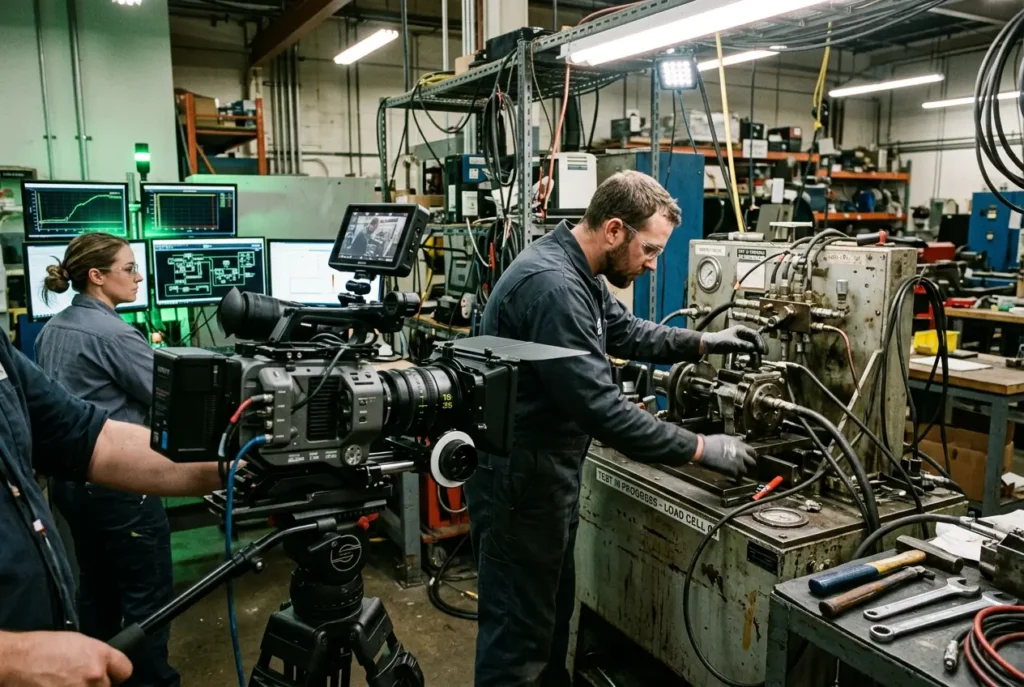
1. Stress-Test Documentation
Executives don’t want to see the product working under perfect conditions; they want to see it fail and recover.
- The Strategy: Filming laboratory-grade stress tests.
- The Result: Validates durability claims with empirical evidence, removing the need for a physical “trial period.”
2. The “Under the Hood” Architecture Tour
For SaaS and hardware alike, showing the internal logic—the API structure, the PCB layout, or the hydraulic flow—builds immediate rapport with the buyer’s engineering team.
- The Strategy: Use high-definition macros or 3D exploded views to explain how the efficiency is achieved.
3. Integration Proof-of-Concepts (PoC)
The most common “late-stage” objection is integration friction.
- The Strategy: Record a 5-minute technical walkthrough of the setup process in a common environment (e.g., Azure, AWS, or a standard manufacturing floor).
Optimizing for AI Search and Generative Engines

Modern B2B buyers often use LLMs to compare vendors. These engines crawl transcripts and metadata to summarize your technical capabilities.
- Semantic Richness: Ensure your video transcripts use precise industry nomenclature (e.g., “ISO 26262 compliance” rather than “safe”).
- Structured Data: Use VideoObject Schema to define segments, allowing AI to pinpoint specific technical answers within a 20-minute video.
- Problem-Solution Phrasing: Frame video titles as technical queries: “How our [Product] manages thermal throttling in high-output cycles.”
Strategic Framework: The “Proof-First” Video Funnel
To effectively reduce objections, videos should be mapped to the technical buyer’s journey:
| Stage | Video Type | Objective |
| Top of Funnel | The “Impossible” Problem | Show a common engineering pain point solved. |
| Middle of Funnel | The Validation Deep Dive | 10–15 minute technical teardown or API walkthrough. |
| Bottom of Funnel | Peer-to-Peer Case Study | A lead engineer from a client company explaining the ROI. |
Dismantling the “Niche Product” Fallacy
A common objection within the C-suite is that “our product is too complex for video.” In reality, the more complex the product, the more essential video becomes.
When a product requires a 50-page white paper to understand, a 10-minute high-fidelity technical video acts as a force multiplier. It allows your internal champion at the target company to “sell up” to the CFO by providing a visual proof of concept that doesn’t require a PhD to interpret, yet retains the technical depth to satisfy the VP of Engineering.
FAQ: Technical Video Marketing in B2B Sales
How does video marketing specifically reduce the length of a technical sales cycle?
Video marketing shortens the sales cycle by front-loading the “Proof of Concept” phase. In a typical B2B cycle, technical vetting happens in the mid-to-late stages, often requiring multiple synchronous meetings. By providing high-fidelity technical demonstrations early, buyers can perform their own “silent vetting.” This eliminates the need for basic technical discovery calls, allowing the first conversation to focus on specific implementation details rather than basic viability.
What is the ideal length for a technical demonstration video?
The length should be dictated by the depth of the objection. For top-of-funnel awareness, 2–3 minutes is sufficient to frame the problem. However, for “High-Intent” technical vetting, videos of 10–20 minutes are highly effective. Data shows that technical decision-makers will watch long-form content if the information density is high and free of marketing fluff. Accuracy and depth are more important than brevity in this context.
Can video content actually replace a physical product trial or pilot program?
While it may not replace a final pilot for multi-million dollar contracts, it can significantly reduce the “Pilot Failure Rate.” By showing the product’s performance in various edge-case scenarios via video, you filter for buyers whose needs are a genuine match. This ensures that when a physical trial does happen, it is a formality rather than a test, saving hundreds of engineering hours for both the vendor and the buyer.
How should we handle proprietary technology in public-facing videos?
This is a strategic balance. You should focus on “The What” and “The Evidence” rather than “The Secret Sauce.” Show the output, the performance metrics, and the interface without revealing protected IP or patented internal schematics. High-level architectural diagrams and external performance validation are usually enough to satisfy a buyer’s skepticism without compromising intellectual property.
Conclusion: Engineering Trust at Scale
In the era of AI-driven procurement and hyper-informed buyers, the traditional sales deck is an insufficient tool. Video marketing for technical sales is not about “engaging” an audience; it is about engineering trust. By documenting proof, visualizing complexity, and addressing objections before they are even voiced, organizations can achieve a measurable 40% reduction in friction.
The companies that win in 2026 will be those that stop “selling” and start “demonstrating.”
Would you like me to develop a 6-month video content roadmap specifically for your lead engineering team?