The cyclical nature of the marine industry presents a persistent challenge for dealership owners and operators. When consumer confidence is high and interest rates are favorable, hull sales drive aggressive top-line revenue growth. However, treating the initial boat sale as the culmination of the customer journey—rather than the beginning—leaves substantial, high-margin revenue on the table.
For executive decision-makers in the marine space, shifting focus to marine service department marketing is not merely a tactic for generating repair work; it is a foundational strategy for financial resilience. Dealerships that consistently achieve high absorption rates—where fixed operations cover the entirety of the dealership’s overhead expenses—insulate themselves against fluctuating retail markets and shifting economic conditions.
Despite this reality, many marine dealerships allocate the overwhelming majority of their marketing budgets to inventory acquisition and new unit sales. The service department, often the most profitable division per square foot, is left to rely on passive foot traffic, warranty work, and reactive customer inquiries.
This article outlines the strategic imperative of marketing your marine service department, providing actionable frameworks to transition your fixed operations from a passive fulfillment center into a proactive, recurring revenue engine.
The Financial Reality: Why Fixed Operations Drive Valuation
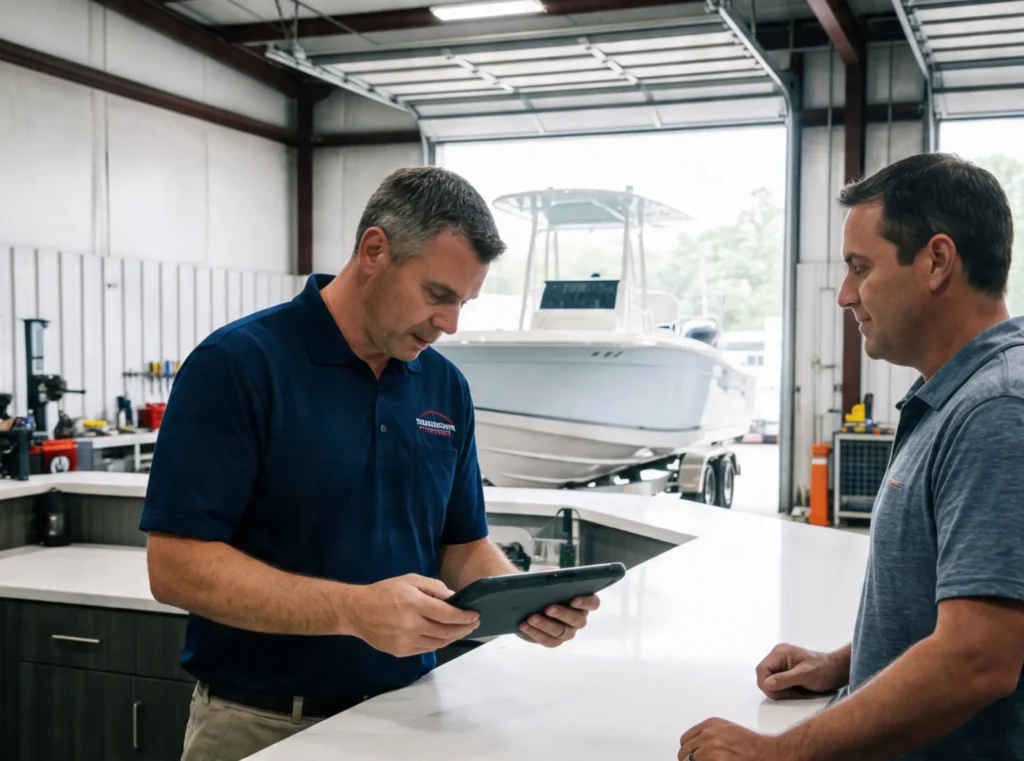
In dealership economics, top-line revenue from unit sales often overshadows the gross profit generated by the back of the house. However, sophisticated operators and private equity buyers evaluating marine assets look directly at fixed operations to determine business health and overall valuation.
Shifting from Transactional to Lifetime Value
The acquisition cost of a new boat buyer is high. Marketing efforts, sales commissions, inventory flooring costs, and closing incentives compress the net margin of the initial transaction. If that customer is lost to an independent boatyard for their 20-hour service, winterization, and eventual repower, the dealership has forfeited the most lucrative phase of the customer lifecycle.
Effective post-sale boat marketing transitions the relationship from a single high-value transaction to a decade-long annuity. A well-maintained 30-foot center console will require routine maintenance, electronics upgrades, fiberglass repair, and seasonal storage—services that collectively yield significantly higher margins than the initial hull sale. By actively marketing these services, dealerships maximize the Lifetime Value (LTV) of every customer acquired by the sales department.
The Absorption Rate Imperative
The ultimate metric of dealership stability is the absorption rate. When parts and service gross profits cover 100% of operating expenses, every hull sold contributes directly to net profit.
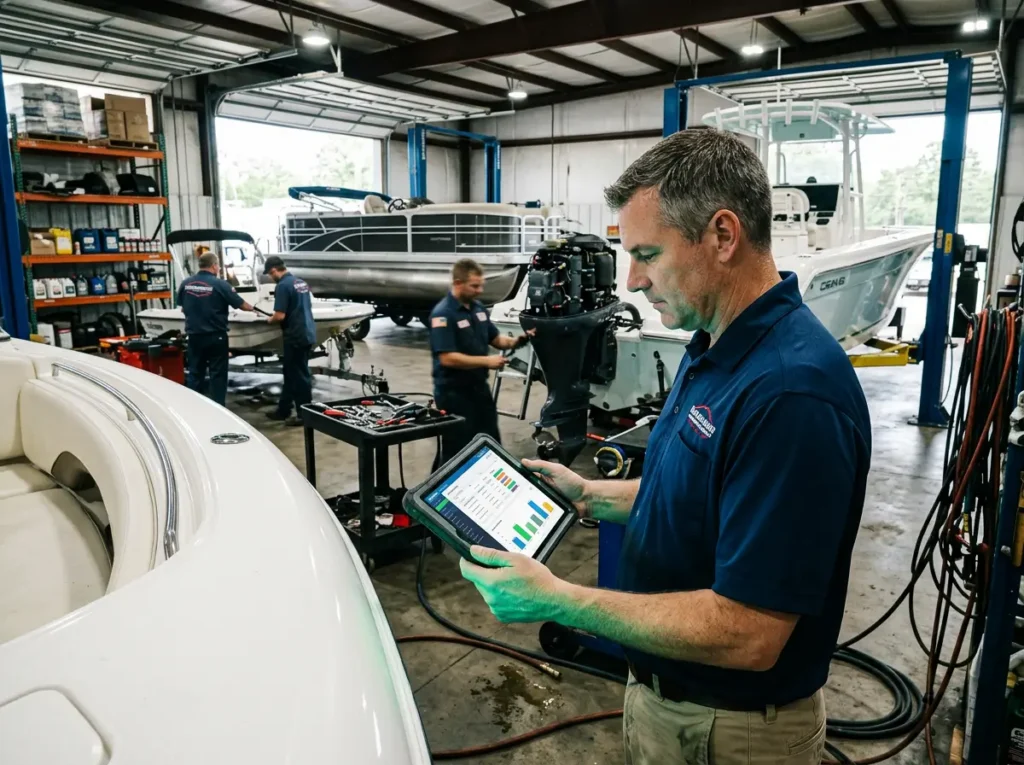
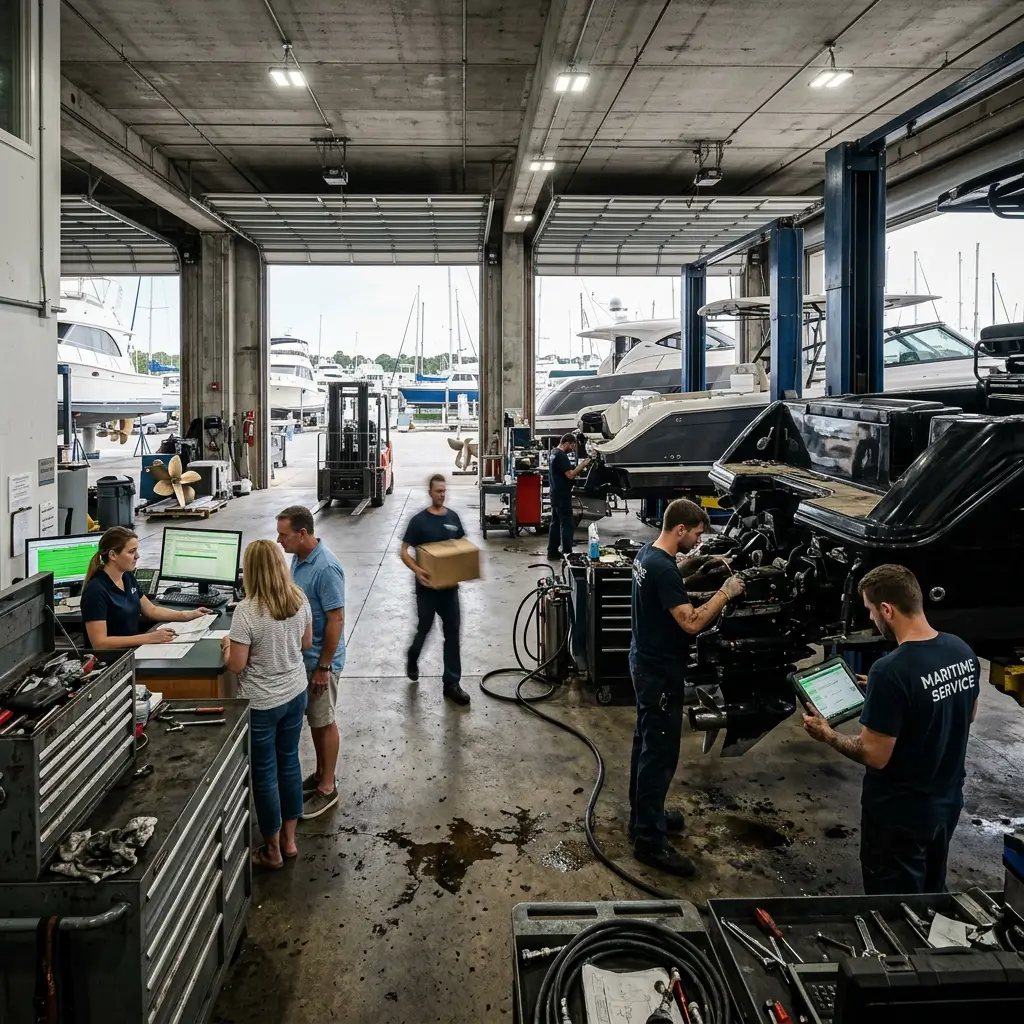
Achieving a 100% absorption rate requires treating the service department as an independent profit center that requires its own dedicated marketing strategy, lead generation funnels, and customer retention campaigns. Relying on the sales department to passively feed the service department is an inefficient model that leaves the dealership vulnerable to seasonal sales slumps.
Foundational Elements of Marine Service Department Marketing
To generate consistent service revenue, marine marketing must evolve from generic brand awareness to highly targeted, data-driven communication. This requires modernizing the dealership’s approach to customer data and communication infrastructure.
Unifying the Customer Data Platform (CDP)
The foundation of effective marine service department marketing is pristine data. Marketing systems must be tightly integrated with the dealership’s Dealer Management System (DMS) to track the exact lifecycle stage of every vessel in the local market.
Operators must segment their database based on actionable parameters:
- Engine hours and maintenance intervals (e.g., 100-hour, 300-hour services).
- Date of purchase and warranty expiration dates.
- Make, model, and engine manufacturer (for targeted recall or upgrade campaigns).
- Historical service records to identify lapsed customers.
When marketing teams have access to unified data, they can deploy campaigns that are contextually relevant, moving away from broad “schedule your service” blasts to highly specific, high-converting communications.
Lifecycle Email and SMS Triggers
Automation is the lever that scales service marketing without increasing headcount. By establishing lifecycle triggers, dealerships can ensure consistent touchpoints that drive service appointments.
For example, an automated email and SMS sequence should be triggered 11 months after a new boat delivery, reminding the owner of their impending annual service and highlighting the importance of maintaining their warranty compliance. Similarly, automated “we miss you” campaigns can be deployed to customers who have not recorded a service RO (Repair Order) in over 18 months, offering a complimentary multi-point inspection to re-engage the relationship.
[Internal Link: Implementing Marine CRM and Marketing Automation]
Digital Visibility for High-Intent Service Queries
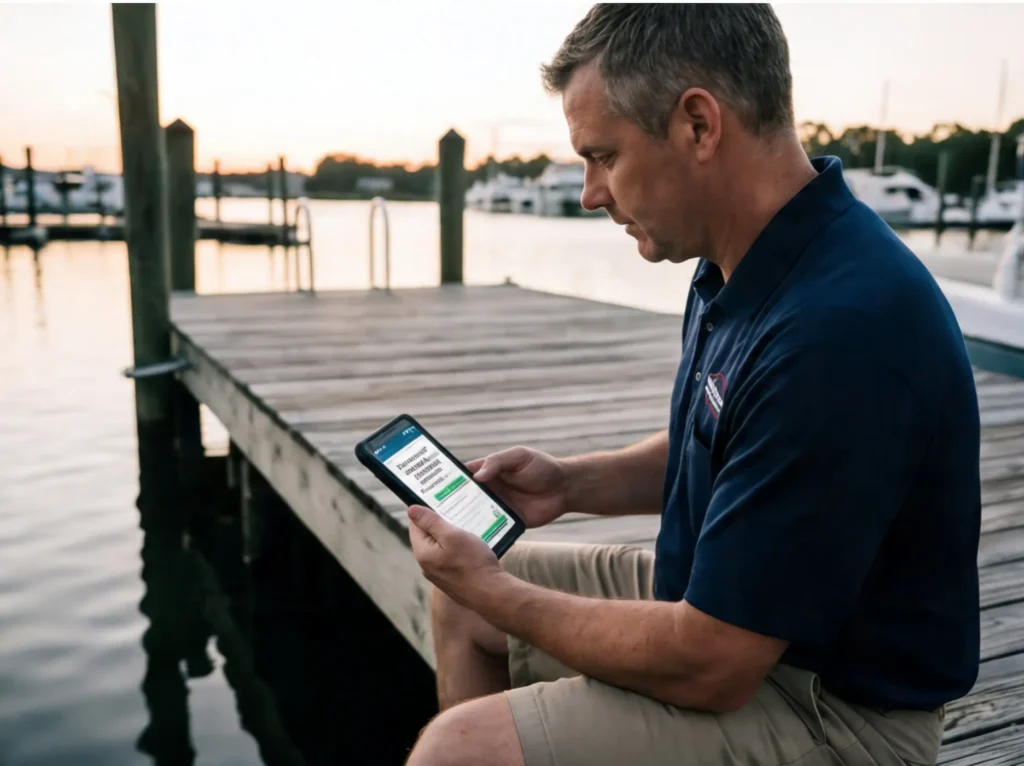
When a boat owner needs immediate service—whether due to a lower unit strike, a malfunctioning chartplotter, or an impending freeze warning—they turn to digital search. If your dealership’s digital presence is entirely optimized for “boats for sale,” you will fail to capture this high-intent, high-margin traffic.
Local SEO and Service-Specific Landing Pages
Broad dealership homepages rarely rank well for specific technical queries. To capture service lead generation for marinas, dealerships must build dedicated, highly optimized landing pages for their core competencies.
A strategic site architecture should include individual pages for:
- Outboard Engine Service & Repowering (Segmented by brand: Yamaha, Mercury, Suzuki)
- Fiberglass and Gelcoat Repair
- Marine Electronics Installation
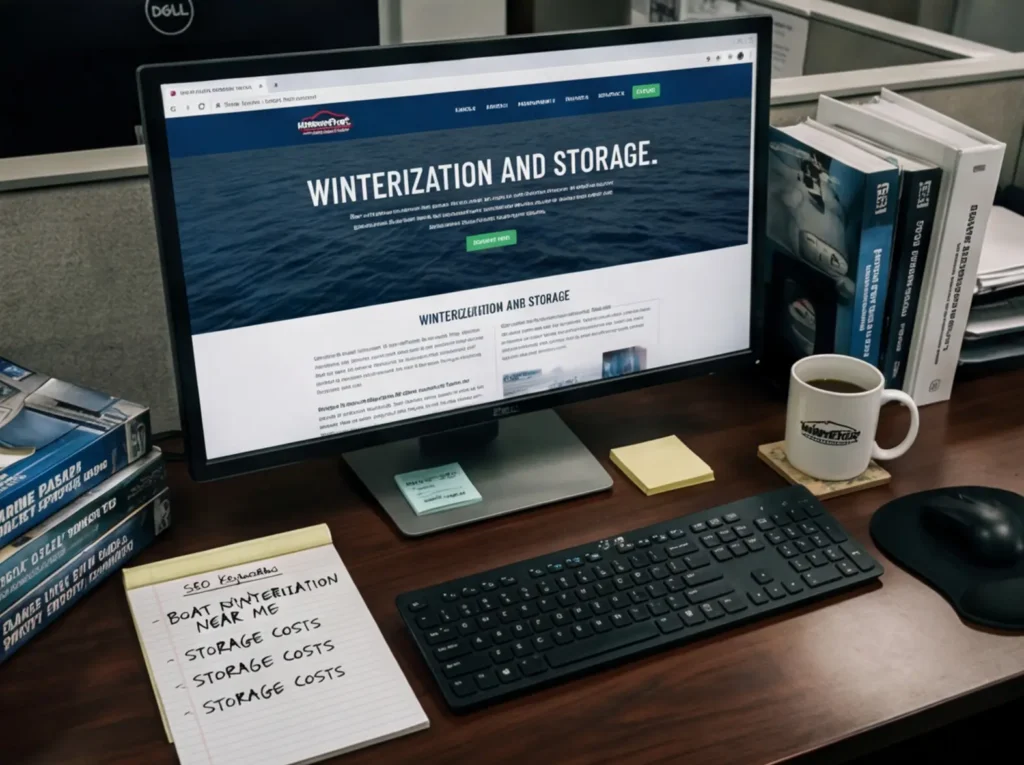
- Winterization and Shrink Wrapping
- Bottom Painting and Running Gear Service
Each page must detail the specific certifications of the technical staff (e.g., Master Marine Technicians), the facility’s capabilities, and clear calls-to-action to schedule an appointment. This granular approach not only improves Google SEO rankings for long-tail, commercial-intent queries but also significantly improves conversion rates by directing users exactly to the information they requested.
Capturing AI Search and Zero-Click Information
The rise of Large Language Models (LLMs) and AI-driven search engines (like Google’s SGE or ChatGPT) is fundamentally altering how consumers find service providers. AI systems synthesize answers by extracting authoritative, structured data from the web.
To optimize for AI retrieval, marine service marketing must focus on semantic depth. Landing pages should include clear, direct answers to common owner questions. For example, explicitly stating your turnaround times, detailing the exact steps included in your winterization package, and providing transparent baseline pricing structures helps AI models confidently recommend your facility when a user prompts: “Where is an authorized Mercury service center near me that does winterization?”
Building a Proactive Service Revenue Engine
Reactive service departments wait for engines to break; proactive service departments market preventative maintenance and asset enhancement. Shifting to a proactive model smooths out seasonal revenue curves and keeps technicians billing hours year-round.
Winterization and Spring Commissioning Campaigns
In seasonal climates, the rush for winterization and spring commissioning often creates operational bottlenecks. Strategic marketing can alleviate this by incentivizing early scheduling.
Deploying tiered campaigns that offer minor pricing advantages or complimentary add-ons (like a free battery load test) for owners who schedule their winterization in early September can pull revenue forward and optimize yard logistics. Furthermore, packaging winterization with off-season upgrade projects—such as new upholstery or lighting—maximizes the revenue per vessel while it sits in storage.
Upselling Upgrades and Preventative Maintenance
The service department is the ideal environment for high-ticket upselling, provided the marketing team supports the service advisors. Marine customer retention strategies should include educational content that highlights the ROI of preventative maintenance.
Marketing can generate demand for repower projects by targeting owners of vessels that are 7–10 years old with case studies on the fuel efficiency and reliability gains of modern four-stroke outboards. Similarly, targeted campaigns promoting the integration of new sonar technologies or gyroscopic stabilizers can transform a routine maintenance visit into a major, high-margin work order.
Frequently Asked Questions (FAQ)
How do we measure the ROI of marine service department marketing? The most accurate method for measuring service marketing ROI is through closed-loop reporting tied directly to your Dealer Management System (DMS). Instead of merely tracking clicks or form submissions, marketing platforms must be integrated to track when a generated lead converts into a closed Repair Order (RO).
Key metrics for executive review should include the Cost Per Acquisition (CPA) for new service customers, the average RO value generated by specific marketing campaigns, and the reactivation rate of lapsed customers. By analyzing these figures against the gross margin of the service department, operators can precisely calculate the return on their marketing investments.
How should a dealership allocate marketing budget between boat sales and service? Budget allocation should not be based on top-line revenue, but rather on gross profit contribution and strategic business objectives. Historically, dealerships allocate 80-90% of their budget to sales. A more optimized approach shifts 20-30% of the total marketing budget directly toward fixed operations.
This reallocation focuses on driving high-margin work and improving the dealership’s absorption rate. Furthermore, service marketing often requires lower overall spend because it leverages owned audiences (existing customer databases) through email and SMS, reducing the reliance on expensive third-party lead aggregators or broad paid search campaigns.
What are the most effective digital channels for driving boat service leads? For immediate, high-intent needs (e.g., “boat repair near me” or “Yamaha outboard mechanic”), Local SEO and highly targeted Google Ads campaigns capturing commercial intent keywords are the most effective channels. Ensuring your Google Business Profile is heavily optimized with service categories, technician certifications, and recent photos of the facility is critical.
For proactive service generation—such as winterization, repowers, or electronics upgrades—direct channels yield the highest conversion rates. Segmented email marketing, SMS reminders tied to maintenance intervals, and targeted social media campaigns directed at past purchasers allow you to generate demand before the customer actively begins searching for a provider.
How does AI search impact how boat owners find repair facilities? Generative AI search engines fundamentally change the discovery phase by providing immediate, synthesized answers rather than a list of blue links. Boat owners are increasingly using conversational queries, such as “What does a 100-hour service on a Yamaha 300 entail, and who is authorized to do it near City?”
To ensure your dealership is recommended by these AI systems, your service website content must move beyond basic brochures. It requires deep semantic optimization, clear structural formatting (using H2s and H3s), and authoritative, detailed explanations of your services, certifications, and processes. AI models prioritize comprehensiveness and clarity, making in-depth, educational service pages a necessity for modern visibility.
Strategic Conclusion
For marine executives focused on sustainable growth and enterprise valuation, the initial hull sale must be viewed as an acquisition channel for the service department, not the end of the revenue road. Transitioning a dealership from a sales-reliant model to one anchored by fixed operations requires a fundamental shift in how marketing capital and focus are deployed.
By unifying customer data, building robust digital visibility for technical services, and deploying proactive, lifecycle-driven campaigns, dealerships can build a highly profitable, recurring revenue engine. Marine service department marketing is the critical lever that maximizes customer lifetime value, drives overhead absorption, and insulates the business from retail market volatility. Operators who master this post-sale ecosystem will systematically outperform competitors who remain trapped in the cycle of chasing the next boat sale.