
Introduction: The Anatomy of Engineering Skepticism
In the high-stakes world of industrial procurement, the “innovative” and “disruptive” labels often fall on deaf ears. For engineers, a new piece of complex machinery isn’t just a purchase; it’s a potential point of failure. Their primary objective is risk mitigation. When marketing to this demographic, the traditional “features and benefits” approach is insufficient.
Engineers are trained to look for the catch. They prioritize physics over phrasing and data over declarations. To successfully market complex machinery in the U.S. industrial sector, you must shift from a persuasive stance to a consultative one. This guide explores the strategic architecture required to dismantle skepticism and build an authoritative bridge between technical capability and commercial value.
I. Quantifying the Technical Value Proposition
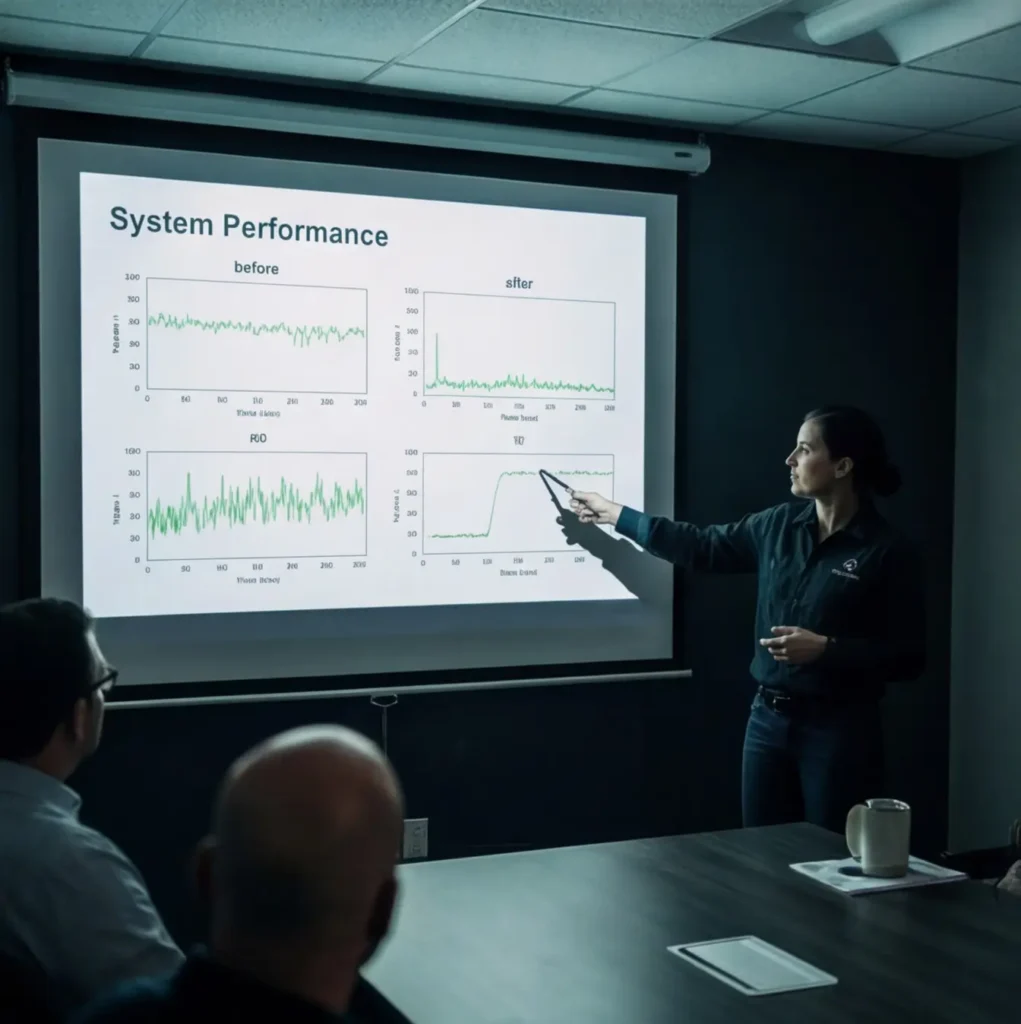
Engineers don’t buy products; they buy verified solutions to specific constraints. To capture their attention, your marketing must mirror the rigor of their own internal evaluation processes.
Moving Beyond Surface-Level Specifications

Standard spec sheets are the bare minimum. To differentiate complex machinery, you must provide the “why” behind the “what.” If your machinery boasts a 15% increase in throughput, the marketing material must detail the mechanical or algorithmic optimization that makes it possible.
- Thermal Dynamics and Stress Testing: Provide documentation on how the machine performs under peak load.
- Integration Compatibility: Address how the hardware interfaces with existing SCADA systems or ERP frameworks via APIs.
- Lifecycle Analysis: Detail the Mean Time Between Failures (MTBF) and specific maintenance intervals.
II. The Hierarchy of Engineering Proof
The skeptical mind requires a hierarchy of evidence. General marketing collateral often fails because it provides “social proof” (logos of famous clients) before it provides “technical proof” (performance data).
1. Raw Data and White Papers
A white paper should not be a glorified brochure. It should be a peer-review-quality document that addresses a specific industry challenge. If you are marketing a new CNC platform or a specialized hydraulic system, lead with the physics. Use charts, schematics, and raw data sets that allow the engineer to perform their own “back-of-the-envelope” calculations.
2. Case Studies as Engineering Logs
Shift your case study format. Instead of the “Challenge-Solution-Result” narrative, use a “Parameter-Variable-Outcome” structure.
- Parameters: What were the exact environmental and operational constraints?
- Variables: How was the machinery configured to meet these needs?
- Outcome: Use hard metrics—tolerances, energy consumption (kWh), and cycle time reductions.
III. Navigating the Multi-Stakeholder Technical Buy-In
In B2B industrial sales, the engineer is often the “gatekeeper,” while the operations manager or CFO is the “economic buyer.” Your content must serve both, but it must satisfy the engineer first. If the engineer doesn’t trust the specs, the project dies before it reaches the CFO’s desk.
Enabling the Internal Champion
Engineers often have to “sell” your solution upward. Provide them with the tools to do so:
- ROI Calculators: Not simple web forms, but downloadable Excel models that allow them to input their own labor rates, energy costs, and material waste.
- CAD and BIM Files: Make it easy for them to drop your machinery into their existing plant layouts.
- Comparison Matrices: Transparently compare your machinery against industry standards. If you are more expensive, explain the engineering trade-off that justifies the cost (e.g., higher grade alloys, proprietary sensors).
IV. Content Strategy: From Specs to Systems Thinking
To rank in both Google and AI-driven search engines (like Perplexity or Gemini), your content must demonstrate topical authority. This means moving beyond the machine itself and discussing the broader system it inhabits.
Addressing the “Edge Cases”
Engineers live in the edge cases. Marketing content that acknowledges where a machine might struggle actually builds more trust than content that claims perfection.
- Example: “While our Model X excels in high-heat environments, it requires a specific filtration kit for high-particulate air quality environments.” This level of transparency eliminates the fear of the “hidden flaw” and positions your brand as an honest technical partner.
V. Leveraging AI and Semantic Search for Technical Discovery
Modern search is no longer just about keywords; it’s about entities and relationships. When an engineer asks an AI, “What is the most reliable high-pressure pump for corrosive chemical processing?” the AI looks for content that understands the relationship between “316L Stainless Steel,” “Cavitation risks,” and “Chemical compatibility.”
- Use Schema Markup: Implement TechnicalArticle and Product schema to help search engines parse your specifications.
- Long-Tail Technical Queries: Optimize for phrases like “low-latency PLC integration for automated assembly” rather than just “automation machinery.”
FAQ: Marketing to Engineers
How do you overcome an engineer’s inherent bias against marketing materials? The bias is usually against the lack of substance, not the medium. To overcome this, lead with “technical transparency.” Ensure that every claim is backed by a verifiable data point or a mechanical explanation. Use engineers to write or vet your content; the “voice” of an engineer is distinct—it is precise, cautious, and focused on constraints. If the tone feels too “salesy,” you will lose them in the first paragraph.
What types of content perform best for technical decision-makers? In-depth technical guides, 3D exploded views, and “teardown” videos are highly effective. Engineers value content that allows them to “see under the hood” without a sales rep present. Long-form white papers that solve a specific problem (e.g., “Mitigating Vibration in High-Speed Precision Milling”) establish your brand as a subject matter expert rather than just a vendor.
How important is third-party validation in the industrial sector? It is critical but must be the right kind of validation. While industry awards are nice, engineers value ISO certifications, UL listings, and independent lab test results much more. Peer validation via forums or technical communities also carries significant weight. Providing a list of “Technical References”—engineers at other firms who can speak to the machine’s performance—is the ultimate form of social proof.
Should price be transparent in complex machinery marketing? While exact pricing is difficult due to customization, providing a “starting at” price or a “Total Cost of Ownership” (TCO) framework is highly beneficial. Engineers and project managers need to know if a solution is in the right ballpark before they invest hours into technical vetting. Transparency regarding the cost of consumables and long-term maintenance is often more important than the initial CAPEX.
Strategic Conclusion: Building the “Technical Bridge”

Success in marketing complex machinery lies in the transition from vendor to partner. By respecting the engineer’s need for data, acknowledging the realities of mechanical failure, and providing the tools for deep technical vetting, you remove the friction in the B2B buying cycle. Skepticism is not an obstacle; it is a filter. When your marketing passes that filter, you don’t just get a lead—you get a long-term technical partnership.
Would you like to explore a specific content pillar? I can draft a technical white paper outline for your flagship product or develop a multi-touch email sequence designed specifically for engineering lead nurture.